Finding a Washington Preceptor for WGU Internships
Washington is a full practice state where qualified nurse practitioners can evaluate, diagnose, treat, and prescribe without a standing physician collaboration requirement. WGU students still identify their own sites and volunteer preceptors and complete CLPS approval.
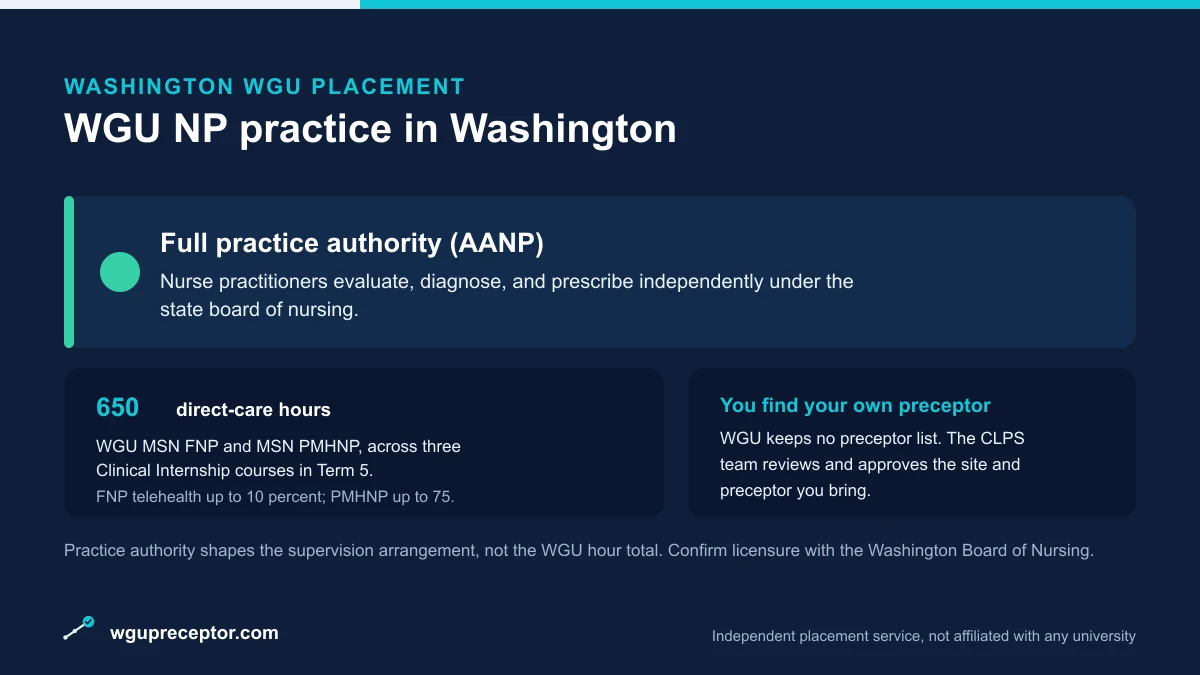
Full practice opens varied Washington settings
AANP categorizes Washington as a full practice state. Advanced registered nurse practitioners can provide core patient care within Washington licensure, certification, competence, and workplace policy without a permanent physician collaboration agreement.
Independent practices, community health centers, behavioral health programs, rural clinics, specialty offices, and health systems can enter a search. Full practice does not establish WGU suitability. Population focus, patient access, schedule, and teaching capacity remain essential.
The student remains supervised. The approved preceptor, WGU Internship objectives, and site policy define permitted activity.
Choose a Washington corridor before outreach
Seattle and Bellevue provide the state's largest mix of primary, psychiatric, adult, women's health, and specialty services. Tacoma and the South Sound form another major market, while Olympia supports a separate search farther south. Everett and Bellingham add northern Puget Sound options.
Spokane anchors eastern Washington. Vancouver is useful in the southwest, though an Oregon site across the river is a separate state location. The Tri-Cities, Yakima, and Wenatchee add central and eastern markets with different health networks.
Traffic, ferries, mountain passes, and winter conditions affect a sustainable radius. Ask sites about student cycles, university relationships, and onboarding lead times before relying on a candidate.
Verify records with the Washington Board
The Washington State Board of Nursing licenses nurses and advanced registered nurse practitioners and provides official ARNP requirements and verification. Check the proposed preceptor's active credential, role, population focus, and public record before detailed paperwork begins.
Request a current CV and confirm patient ages, diagnoses, clinical volume, available days, student experience, and direct supervision. FNP and PMHNP Internships require different patient exposure, so examine the actual practice environment.
Identify who can authorize learners. Large Washington systems may centralize student decisions, while smaller practices may decide locally. Both need authority to sign documents and complete onboarding.
Confirm current WGU state availability
Washington's full practice category does not prove current WGU enrollment or placement eligibility. Confirm WGU state availability and any location-specific restrictions before sourcing. This page cannot establish that a particular practice will be approved.
Use the actual site address and expected patient locations. This matters for Vancouver-area sites, border communities, and virtual arrangements involving patients in another state.
Complete the check before asking an organization to begin an Affiliation Agreement that may take months. Early confirmation gives physical and virtual planning a valid foundation.
Engage CLPS about one year before Internship I
WGU NP students identify their own clinical sites and preceptors. WGU keeps no student preceptor list. A Placement Coordinator in Clinical Learning and Placement Support, or CLPS, reviews the proposed Washington site and volunteer preceptor and helps establish an Affiliation Agreement.
The agreement can take up to six months. Engage the coordinator about one year before Clinical Internship I to allow time for review, negotiation, organizational documents, and onboarding. A verbal commitment is not completed approval.
The site may require background materials, health records, privacy education, learner applications, or orientation. Track these tasks with the CLPS process and wait for all required approvals before starting.
Distribute 650 hours across three courses
WGU's MSN FNP and PMHNP tracks each require 650 direct patient care hours across three Clinical Internship courses and at least two sites. Confirm the current handbook and setting rules before deciding how much a Washington practice can support.
Ask whether the site can host across terms, which objectives its patient panel supports, and whether its weekly schedule is stable. Begin the second-site plan early because another affiliation process may be necessary.
Current telehealth caps differ. FNP may use up to 10 percent, or 65 hours, through approved telehealth. PMHNP may use up to 75 percent. Confirm WGU acceptance, state requirements, patient location, supervision, and site policy before counting remote care.
Compare physical placement and virtual preceptorship
We source physical placements and virtual preceptorship routes. Physical sourcing can target a Washington corridor, specialty, and workable commute. Virtual sourcing can identify supervised telehealth within the track cap and subject to state, site, patient-location, course, and WGU requirements.
Students see the proposed match before payment and pay only when a placement is secured. Preceptors are unpaid volunteers. The service fee covers sourcing and coordination, with pricing on the cost page. WGU and the site retain approval authority.
Provide your track, Internship course, Washington region, travel radius, target term, weekly schedule, and telehealth needs through a free placement review. We will assess physical and virtual routes after state availability is confirmed.
Good to know
Is Washington a full practice state?
Yes. AANP categorizes Washington as full practice, though WGU learners remain supervised and require university and site approval.
Does WGU keep a Washington preceptor list?
No. Students identify sites and volunteer preceptors, and a CLPS Placement Coordinator reviews them and helps with affiliation.
How early should Washington affiliation begin?
An Affiliation Agreement can take up to six months, so engage the coordinator about one year before Clinical Internship I.
Can Washington hours include telehealth?
Approved telehealth may count within current caps of 65 FNP hours and up to 75 percent for PMHNP, subject to all requirements.
Stop cold-emailing clinics
Tell us your track, your city, and your clinical timeline. We will come back with a placement plan and a realistic path to clearing your 650 hours.