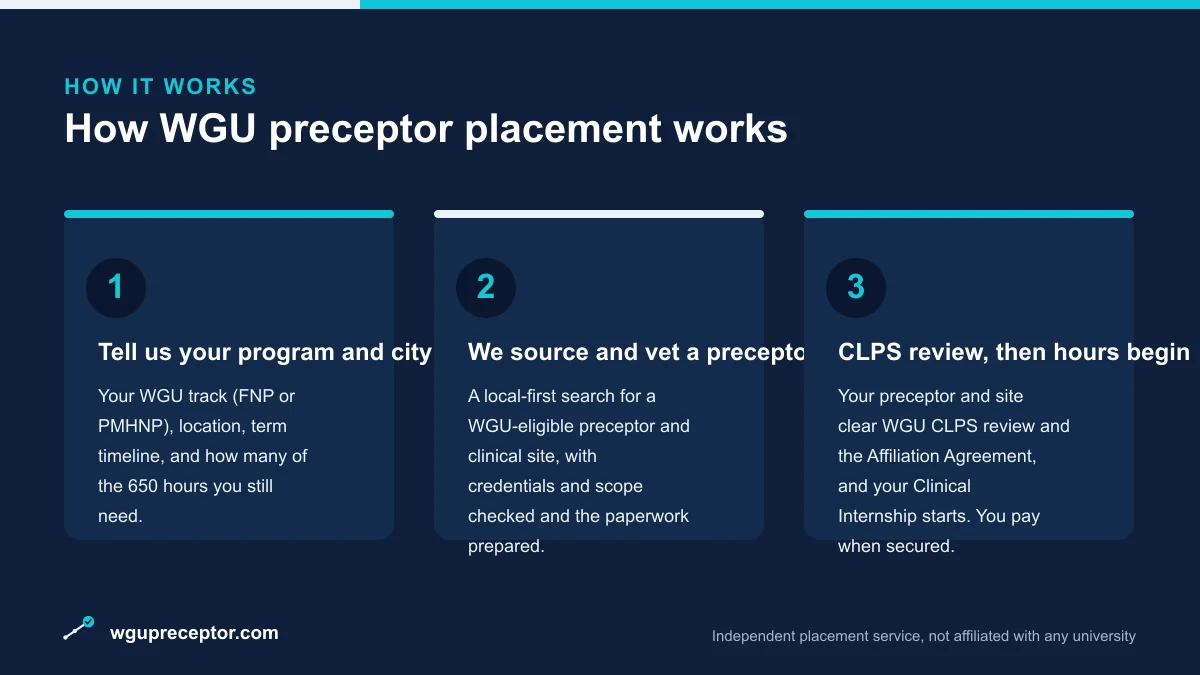
How Our WGU Preceptor Placement Works
Western Governors University makes NP students find their own preceptor. The Michael O. Leavitt School of Health keeps no list of preceptors and will not source or assign one for you; the Clinical Learning and Placement Support team reviews and approves the preceptor and sites you bring. We are an independent placement service that does the finding and verifying for you, then shepherds the Affiliation Agreement so you clear your Field Experience Page on time. Here is exactly how our process runs, start to finish.
What does WGU actually require you to do yourself?
WGU requires you to secure your own preceptor and a minimum of two clinical sites, then submit them to your Placement Coordinator for review and approval. The Placement Coordinator, part of the Clinical Learning and Placement Support (CLPS) team, reviews and approves the preceptor and site and helps establish the Affiliation Agreement, but does not source or assign the preceptor. That sourcing burden falls entirely on the student.
This is where most students stall. You are cold-contacting practices, confirming credentials against WGU's eligibility rules, and hoping a site's legal team will sign a contract that can take up to six months to negotiate. We take that whole workstream off your plate for the MSN FNP and PMHNP tracks, the post-master's APRN certificates, and the RN-to-BSN community field experience.
How do you identify a WGU-approvable preceptor?
We identify a preceptor who already meets WGU's eligibility rules before we ever send the name to your Placement Coordinator, so nothing bounces back at approval. Every WGU preceptor must hold an active unencumbered license, national certification in the specialty, and at least two years of current specialty experience.
For FNP, that means a board-certified NP (family, adult, peds, neonatal, women's health, or geriatric), an MD or DO board-certified in Family or Internal Medicine, or a CNM at MSN or higher. For PMHNP, that means a board-certified psychiatrist, PMHNP, or a qualifying licensed behavioral-health provider within WGU's limits. We verify the license, the certification, and the experience against these rules so the preceptor you submit is one WGU can actually approve.
How do you secure both required sites?
We secure a minimum of two clinical sites because WGU requires it, and we confirm each site will accept a WGU student and sign the paperwork. A preceptor without a willing site is not a placement, so we work both sides at once: the clinician who will teach you and the organization whose legal team must sign.
We also account for WGU's telehealth caps when we structure the sites. FNP students may complete up to 10 percent of hours (65 hours) via telehealth; PMHNP students may complete up to 75 percent of hours via telehealth. The remainder must be in person, so the sites we secure have to support the in-person balance your track requires.
How does compliance through DISA and Complio work?
Compliance runs through DISA Healthcare Technology (formerly American DataBank) on the Complio platform, which handles your background check and immunizations. We help you get through it cleanly so a missing document does not delay your start.
Individual sites frequently layer their own onboarding on top of this. Depending on the site, you may also need to clear ACEMAPP, CastleBranch, or a similar platform. We flag those site-specific requirements early so you are not scrambling to satisfy two systems at once during your Clinical Internship term.
Why does the Affiliation Agreement need shepherding?
The Affiliation Agreement is a legal contract between WGU and your clinical site, and it can take up to six months to negotiate. That timeline is the single biggest reason NP students miss their intended start term. This is why WGU tells students to engage the Placement Coordinator about one year before Clinical Internship I.
We shepherd this contract by getting the right documents to the right people, tracking redlines between the site's legal team and WGU, and keeping the negotiation moving so it lands before your term begins. We do the legwork; the Placement Coordinator still helps establish the agreement on WGU's side.
How do you make sure hours are logged correctly?
Your hours are logged inside WGU's own Field Experience Page and Activity Log in the Student Portal; there is no outside system for this. Our job ends where WGU's system begins: we make sure the preceptor and both sites are confirmed and the Affiliation Agreement is in place so that when you open the Field Experience Page, everything you need to log against is already approved.
FNP and PMHNP students log 650 direct patient care clinical hours across three Clinical Internship courses (Kansas residents seeking Kansas licensure who started on or after March 1, 2025 log 750). Getting to that first logged hour on schedule is the outcome we are hired to deliver.
What does this service cost and when do you pay?
Independent NP preceptor placement runs roughly 1,500 to 2,500 dollars per rotation, with psychiatric placements at the higher end. You pay only once the preceptor and site are confirmed. Our fee covers sourcing, verification, and the affiliation-agreement legwork; it is never a payment to the preceptor.
Preceptors are unpaid volunteers, and nothing we charge is passed to them. For scope, we serve the MSN FNP and PMHNP tracks, the post-master's APRN certificates, and the RN-to-BSN community field experience; we do not serve prelicensure BSN placements because WGU secures those itself.
Your WGU placement timeline, stage by stage
| Stage | What happens | Timing |
|---|---|---|
| 1. Engage Placement Coordinator | You open the process with WGU's CLPS team | About 1 year before Clinical Internship I |
| 2. Source and verify | We identify a WGU-approvable preceptor and both sites | Early, in parallel |
| 3. Affiliation Agreement | Legal contract negotiated between WGU and each site | Up to 6 months per site |
| 4. Compliance | Background check and immunizations via DISA and Complio | Before hours start |
| 5. Log clinical hours | 650 direct-care hours on the Field Experience Page | Term 5 |
Good to know
Will WGU find my preceptor if I wait long enough?
No. WGU keeps no list of preceptors and does not source or assign one. The Placement Coordinator reviews and approves the preceptor you bring and helps establish the Affiliation Agreement, but the finding is on you unless you hire an independent service to do it.
How early should I start this process?
Engage the Placement Coordinator about one year before Clinical Internship I. Because the Affiliation Agreement can take up to six months to negotiate, starting the search a year out is what keeps your Term 5 internship on schedule.
Do you pay the preceptor for me?
No. Preceptors are unpaid volunteers, and our fee is never a payment to a preceptor. Our charge covers sourcing, verification, and the affiliation-agreement legwork only.
Do you handle prelicensure BSN placements?
No. WGU secures prelicensure BSN placements itself, so we do not serve them. We serve the MSN FNP and PMHNP tracks, the post-master's APRN certificates, and the RN-to-BSN 35-hour community field experience.
Are you affiliated with WGU?
No. We help you meet WGU's own requirements; WGU's Placement Coordinator still approves the preceptor and site.
Sources: WGU MSN FNP program, WGU FNP clinical experience, NCSBN APRN Consensus Model.
Stop cold-emailing clinics
Tell us your track, your city, and your clinical timeline. We will come back with a placement plan and a realistic path to clearing your 650 hours.