Organizing a Virginia WGU Preceptor Search
Virginia is a restricted practice state, although qualified nurse practitioners can obtain autonomous practice status after meeting state experience requirements. WGU students still identify their own sites and volunteer preceptors and complete CLPS review.
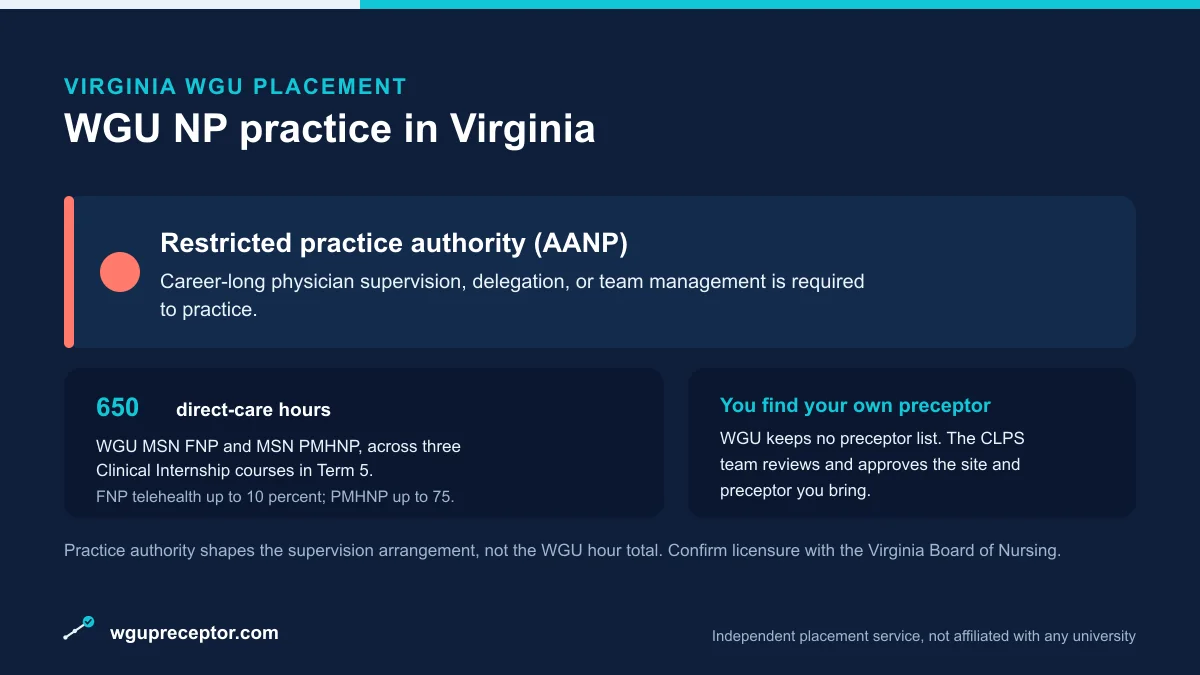
Virginia combines restricted practice and autonomy
AANP categorizes Virginia as a restricted practice state. Virginia also offers an autonomous practice pathway for qualified nurse practitioners who document at least three years and 5,400 hours of qualifying practice under a practice agreement. Other NPs continue under applicable state relationship requirements.
Verify the proposed preceptor's current status rather than assuming authority from experience. Then assess population focus, patient access, schedule, and teaching capacity. Autonomous status relates to professional practice and does not establish WGU Internship fit.
The student remains supervised in either setting. WGU course objectives, site policy, and the approved preceptor define clinical activity.
Use Virginia Board records and a clinical screen
The Virginia Board of Nursing publishes advanced practice registered nurse resources and official verification. Check the candidate's active license, APRN role, specialty, autonomous status when applicable, and public record before detailed paperwork begins.
Request a current CV and confirm patient ages, diagnoses, weekly volume, available shifts, student history, and direct supervision. FNP needs appropriate primary care exposure, while PMHNP needs substantial psychiatric assessment and management.
Find the site's educational decision maker. Large health systems often centralize student approval. Independent practices may decide locally, but they still need authority to complete agreements and onboarding.
Break Virginia into workable search markets
Northern Virginia has a dense mix of primary, psychiatric, adult, women's health, and specialty care, though traffic makes a precise radius important. Richmond offers another broad market. Hampton Roads, including Norfolk, Virginia Beach, Chesapeake, and Newport News, supports a large coastal search.
Charlottesville and Roanoke are useful western and central anchors. Winchester and the Shenandoah Valley broaden northern options. Lynchburg, Danville, Bristol, and Abingdon add regional possibilities outside the largest metros.
A site in Washington, DC, Maryland, West Virginia, Tennessee, North Carolina, or Kentucky is a different jurisdiction. Use the actual site address when asking WGU about placement availability.
Confirm current WGU availability first
Virginia practice authority does not prove WGU enrollment or placement eligibility. Confirm current WGU state availability and any location-specific restrictions before approaching clinicians. This page cannot establish that a proposed site will be accepted.
The same check applies to virtual care and patient locations. A preceptor may be based in Virginia while patients are elsewhere, creating additional state and WGU review questions.
Complete eligibility review early because an Affiliation Agreement can take months. It prevents the organization from beginning a lengthy process for an unusable location.
Start CLPS coordination well ahead of Internship I
WGU NP students identify their own sites and preceptors. WGU does not maintain a student preceptor list. A Placement Coordinator in Clinical Learning and Placement Support, or CLPS, reviews the proposed Virginia clinician and site and helps establish the Affiliation Agreement.
An agreement can take up to six months. Engage the coordinator about one year before Clinical Internship I to allow for candidate review, negotiation, organizational documents, and onboarding. A verbal yes is not completed approval.
Virginia sites may require health records, background screening, privacy education, learner applications, or orientation. Track these with CLPS tasks and wait for required approval before starting.
Plan 650 hours and at least two sites
WGU's MSN FNP and PMHNP tracks each require 650 direct patient care hours across three Clinical Internship courses and at least two sites. Confirm the current handbook, course sequence, and eligible settings before assigning expected hours to a Virginia practice.
Ask how many terms the site can host, which objectives its patients support, and whether the schedule can provide consistent hours. The second-site requirement remains even with a strong first match, so begin its agreement process early.
Telehealth caps differ. FNP may complete up to 10 percent, or 65 hours, through approved telehealth. PMHNP may complete up to 75 percent. Confirm WGU acceptance, state rules, patient location, supervision, and site policy before relying on virtual care.
Compare physical and virtual sourcing routes
We source physical placements and virtual preceptorship routes. Physical sourcing can target a Virginia market, specialty, and workable commute. Virtual sourcing can identify supervised telehealth within the track cap and subject to state, patient-location, site, course, and WGU requirements.
Students see the proposed match before payment and pay only when a placement is secured. Preceptors are unpaid volunteers. The fee covers sourcing and coordination, with pricing on the cost page. WGU and the site retain approval authority.
Share your track, Internship course, Virginia region, travel radius, target term, weekly availability, and telehealth needs through a free placement review. We will assess physical and virtual routes after current state availability is confirmed.
Good to know
Is Virginia a restricted practice state?
Yes. AANP categorizes Virginia as restricted practice, although qualified NPs may obtain autonomous status after meeting state requirements.
What is Virginia autonomous practice status?
It is a state pathway for qualified NPs who document at least three years and 5,400 hours of qualifying practice under an agreement.
Does WGU provide a Virginia preceptor list?
No. Students identify sites and volunteer preceptors, and a CLPS Placement Coordinator reviews the proposal and helps with affiliation.
Can Virginia clinicals include virtual care?
Approved telehealth may count within the track cap, subject to state, patient-location, site, supervision, course, and WGU requirements.
Stop cold-emailing clinics
Tell us your track, your city, and your clinical timeline. We will come back with a placement plan and a realistic path to clearing your 650 hours.