Finding the Right Texas Preceptor for WGU
Texas is a restricted practice state where nurse practitioners work within state requirements for physician delegation or involvement. WGU students identify their own sites and volunteer preceptors, then complete CLPS review and affiliation requirements.
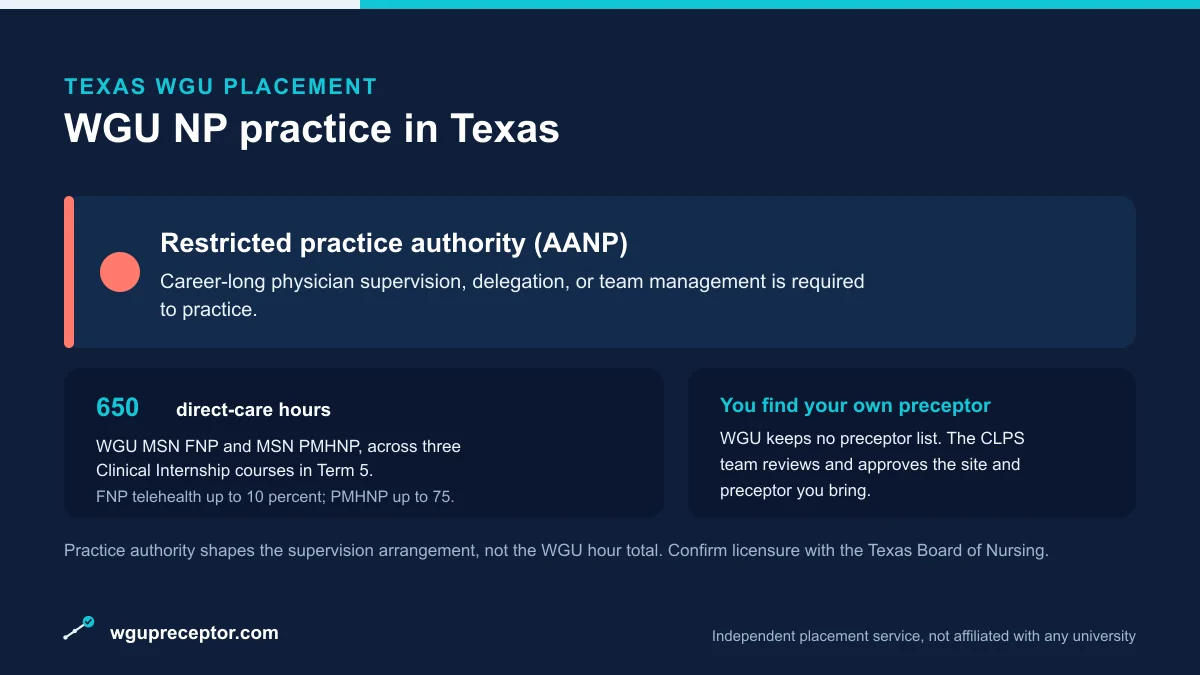
Texas restricted practice shapes the first screen
AANP categorizes Texas as a restricted practice state. Nurse practitioners provide assessment, diagnosis, treatment, and prescribing care within Texas licensure and delegation requirements. The proposed clinician's current practice structure and prescriptive authority should be verified at the intended site.
Then evaluate population focus, patient access, weekly schedule, and teaching capacity. A compliant Texas NP can be an excellent clinical educator, but a valid credential does not by itself establish FNP or PMHNP Internship fit.
The WGU learner remains supervised. Course objectives, site policy, and the approved preceptor define the student's clinical activity.
Divide a large state into practical search regions
Dallas and Fort Worth, Houston, San Antonio, and Austin contain the largest concentrations of primary care, psychiatric services, women's health, adult care, and specialties. Traffic makes drive time more useful than mileage when setting a radius.
El Paso, Lubbock, Amarillo, Abilene, Waco, Temple, Killeen, and Corpus Christi provide regional anchors. McAllen and Brownsville support Rio Grande Valley searches. Tyler, Longview, Beaumont, Midland, and Odessa add eastern and western markets.
Define weekly clinical days and travel limits before outreach. Tell sites the WGU track, Internship course, dates, expected hours, and affiliation process so they can assess capacity.
Use Texas Board of Nursing verification
The Texas Board of Nursing licenses registered nurses and recognizes advanced practice registered nurses. Check the proposed preceptor's active license, APRN recognition, population focus, prescriptive authority when relevant, and public disciplinary record.
Request a current CV and confirm patient ages, common diagnoses, weekly volume, schedule, student history, and direct supervision. FNP and PMHNP Internships require distinct care exposure, so examine the actual setting rather than relying on the organization type.
Large Texas health systems often use centralized education offices and long application cycles. An individual clinician's interest may not be enough without organizational authority and completed onboarding.
Confirm WGU availability at the actual address
Texas practice rules do not prove WGU enrollment or placement eligibility. Confirm current WGU state availability and any clinical restrictions before sourcing. This page cannot establish that a particular Texas site will be accepted.
Use the physical site address and planned patient locations. Texas borders several states and Mexico, and virtual care may involve patients in different jurisdictions. WGU must review the actual location pattern.
Complete this check before asking an organization to begin an Affiliation Agreement that can take months. Early confirmation protects both the student and the site from avoidable work.
Engage CLPS well before Internship I
WGU NP students identify their own preceptors and clinical sites. WGU does not keep a student preceptor list. A Placement Coordinator in Clinical Learning and Placement Support, or CLPS, reviews the proposed Texas clinician and site and helps establish the Affiliation Agreement.
An agreement can take up to six months. Engage the coordinator about one year before Clinical Internship I to allow for credential review, negotiation, organizational documents, and onboarding. A verbal yes is not final approval.
Texas organizations may require health records, background screening, privacy training, learner applications, or orientation. Keep these tasks aligned with the CLPS process.
Plan 650 direct patient care hours across sites
WGU's MSN FNP and PMHNP tracks each require 650 direct patient care hours across three Clinical Internship courses and at least two sites. Confirm the current handbook, course sequence, and setting requirements before assigning expected hours to a Texas practice.
Ask whether the site can host across terms, which objectives it supports, and whether its weekly patient volume is dependable. Even a long-term first site does not remove the at-least-two-site requirement, so begin planning the second agreement early.
Telehealth limits differ. FNP permits up to 10 percent, or 65 hours, through approved telehealth. PMHNP permits up to 75 percent. Confirm WGU acceptance, state rules, patient location, supervision, and site policy before relying on remote activity.
Compare physical and virtual routes
We source physical placements and virtual preceptorship routes. Physical sourcing can target a specific Texas market and schedule. Virtual sourcing can identify supervised telehealth within the track cap and subject to state, patient-location, site, course, and WGU requirements.
Students review the match before payment and pay only when a placement is secured. Preceptors are unpaid volunteers, and the fee covers sourcing and coordination. Pricing is explained on the cost page. WGU and the site retain approval authority.
Share your track, Internship course, Texas region, travel radius, target term, weekly schedule, and telehealth needs through a free placement review. We will compare physical and virtual routes after current state availability is confirmed.
Good to know
Is Texas a restricted practice state?
Yes. AANP classifies Texas as restricted practice because state requirements mandate physician involvement in at least one element of NP practice.
Does WGU keep a Texas preceptor list?
No. Students identify their sites and volunteer preceptors, while a CLPS Placement Coordinator reviews them and helps with affiliation.
Why should Texas sourcing start early?
The Affiliation Agreement can take up to six months, and Texas organizations may have additional review and onboarding timelines.
Can a WGU Texas placement be virtual?
Approved telehealth may count within track limits, subject to state, patient-location, site, supervision, course, and WGU requirements.
Stop cold-emailing clinics
Tell us your track, your city, and your clinical timeline. We will come back with a placement plan and a realistic path to clearing your 650 hours.