How to Plan a Tennessee Preceptor Search for WGU
Tennessee is a restricted practice state where state requirements mandate physician involvement in at least one element of nurse practitioner practice. WGU students identify their own clinical sites and volunteer preceptors and complete CLPS review.
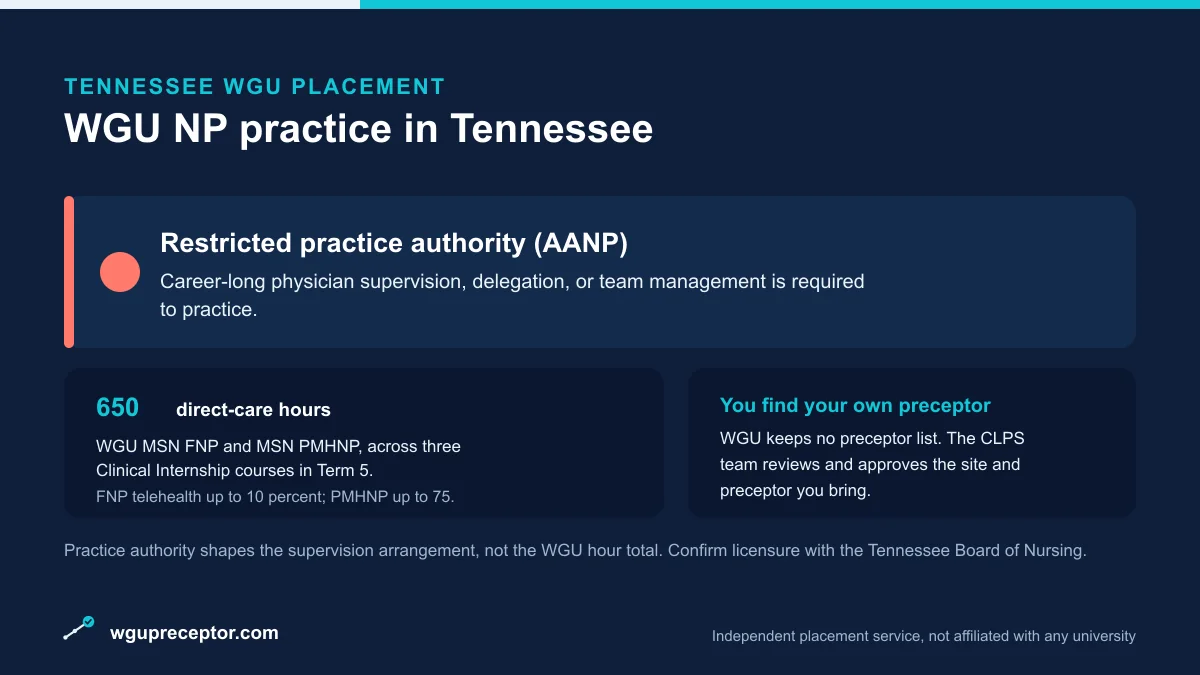
Restricted practice changes candidate screening
AANP categorizes Tennessee as a restricted practice state. Nurse practitioners deliver primary, psychiatric, adult, women's health, and specialty care within Tennessee authorization and required professional relationships. The clinician's current practice arrangement must fit the proposed site.
Ask how the relevant practice and prescribing requirements function. Then confirm population focus, patient access, schedule, and teaching capacity. A compliant, experienced NP may still be unsuitable for the particular WGU FNP or PMHNP Internship.
The learner remains supervised. WGU course objectives, site policy, and the approved preceptor determine permitted clinical activity.
Confirm state availability before site work
Tennessee's practice category does not prove WGU enrollment or placement eligibility. Confirm current WGU state availability and any location-specific restrictions before contacting clinicians. This page cannot establish that WGU will approve a particular practice.
Use the physical site address. A clinic across the Kentucky, Virginia, North Carolina, Georgia, Alabama, Mississippi, Arkansas, or Missouri border is a different state location and requires separate review.
Complete this check early because an Affiliation Agreement can take up to six months. An eligible route should be established before asking an organization to invest time in documents.
Verify the clinician through the Tennessee Board
The Tennessee Board of Nursing, within the Department of Health, licenses nurses and advanced practice nurses and provides official verification. Review the proposed preceptor's active license, APRN status, population focus, prescribing information where relevant, and public record.
Request a current CV and ask about patient ages, diagnoses, weekly volume, available shifts, student history, and direct supervision. Confirm suitable primary care exposure for FNP or psychiatric assessment and management for PMHNP.
Identify the organizational education contact. Tennessee health systems may centralize student decisions, while independent practices may decide locally. Both need authority to approve learners, sign documents, and complete onboarding.
Use Tennessee's separate clinical markets
Nashville has a broad mix of health systems, private practices, community care, behavioral health, women's health, and specialties. Franklin, Murfreesboro, and Hendersonville broaden the Middle Tennessee radius, and Clarksville adds a northwestern option.
Memphis anchors West Tennessee, with Jackson providing a regional market east of the city. Knoxville is the main eastern hub, while Chattanooga has its own hospital and outpatient network. Johnson City, Kingsport, and Bristol form the Tri-Cities market.
Set travel limits around traffic and early shifts. Ask sites about student cycles and give them the track, Internship course, dates, weekly schedule, and WGU affiliation expectations.
Begin CLPS coordination about one year ahead
WGU NP students identify their preceptors and clinical sites. WGU has no student preceptor list. A Placement Coordinator in Clinical Learning and Placement Support, or CLPS, reviews the proposed Tennessee clinician and site and helps establish an Affiliation Agreement.
The agreement can take up to six months. Engage the coordinator about one year before Clinical Internship I to provide time for review, agreement negotiation, and site onboarding. A verbal commitment is not completed university approval.
The practice may require health documentation, a background review, privacy education, learner applications, or orientation. Track site requirements and CLPS tasks together.
Plan the 650-hour sequence and second site
WGU's MSN FNP and PMHNP tracks each require 650 direct patient care hours across three Clinical Internship courses and at least two sites. Confirm the current handbook and course settings before relying on a Tennessee match for a particular portion.
Ask how many terms the site can host, which objectives it supports, and whether patient volume can sustain the schedule. The second-site requirement remains even when the first site is strong, so start its search and affiliation work early.
Current telehealth caps differ. FNP may complete up to 10 percent, or 65 hours, through approved telehealth. PMHNP may complete up to 75 percent. Confirm WGU acceptance, patient location, state rules, supervision, and site policy before counting remote care.
Compare physical placement and virtual preceptorship
We source physical placements and virtual preceptorship routes. A physical search can target Tennessee markets and regional practices within a workable commute. Virtual sourcing can identify supervised telehealth within the track cap and subject to state, site, patient-location, course, and WGU requirements.
Students see the proposed match before payment and pay only when a placement is secured. Preceptors are unpaid volunteers. The fee covers sourcing and coordination, with pricing on the cost page. WGU and the site retain approval authority.
Provide your track, Internship course, Tennessee location, travel radius, target term, schedule, and telehealth needs through a free placement review. We will assess physical and virtual routes after current state availability is confirmed.
Good to know
Is Tennessee a restricted practice state?
Yes. AANP classifies Tennessee as restricted practice because state requirements mandate physician involvement in at least one element of NP practice.
Who finds a WGU preceptor in Tennessee?
The student identifies the site and volunteer preceptor. A CLPS Placement Coordinator reviews the proposal and helps with affiliation.
How many clinical hours are required?
WGU's MSN FNP and PMHNP tracks each require 650 direct patient care hours across three Internship courses and at least two sites.
Can Tennessee hours include telehealth?
Approved telehealth may count within current caps of 65 FNP hours and up to 75 percent for PMHNP, subject to all applicable requirements.
Stop cold-emailing clinics
Tell us your track, your city, and your clinical timeline. We will come back with a placement plan and a realistic path to clearing your 650 hours.