Preparing a South Dakota WGU Preceptor Search
South Dakota is a full practice state, although newly licensed nurse practitioners complete a state transition requirement before practicing without collaboration. WGU students still source their own sites and volunteer preceptors and complete CLPS approval.
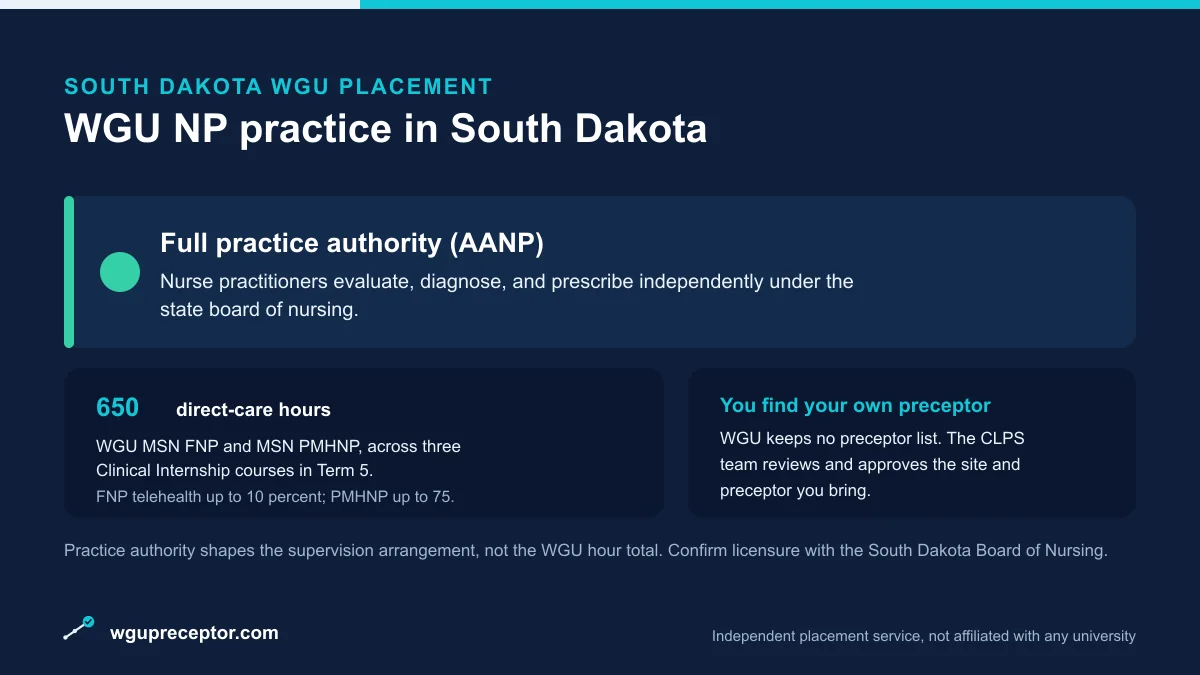
Full practice includes an early-career transition
AANP categorizes South Dakota as a full practice state. Nurse practitioners who satisfy state licensure and transition requirements can evaluate, diagnose, treat, and prescribe without a permanent physician collaboration mandate. Newly licensed NPs follow the state's transition-to-practice framework.
Verify whether the proposed preceptor has completed any applicable transition requirements and is practicing under the correct current arrangement. Full practice can make rural and independent settings relevant, but it does not make every clinician a WGU course match.
The student remains supervised. The WGU Internship objectives, site policy, and approved preceptor determine learner activity regardless of the clinician's professional authority.
Use South Dakota Board records for screening
The South Dakota Board of Nursing, within the Department of Health, licenses nurses and APRNs and publishes statutes, rules, and verification resources. Check the candidate's active license, APRN status, population focus, transition status when relevant, and public record.
Request a current CV and confirm patient ages, diagnoses, clinical volume, available shifts, student experience, and direct supervision. A rural setting may offer broad exposure, but its patient panel still must fit the specific FNP or PMHNP Internship.
Find the person authorized to approve learners. Regional health systems and tribal organizations may use central processes, while independent practices may decide locally. Both need to complete site and university documents.
Confirm current WGU availability before outreach
AANP's full practice category does not prove current WGU enrollment or placement eligibility. Confirm WGU state availability and any South Dakota restrictions before sourcing. This page cannot establish that a specific site will be accepted.
Use the actual clinical address in the question. A site in North Dakota, Minnesota, Iowa, Nebraska, Wyoming, or Montana is a different state placement, even if it creates a practical drive.
Complete the location check before a practice begins an Affiliation Agreement that can take months. Early confirmation also frames which physical and virtual options WGU may consider.
Plan for distance between clinical hubs
Sioux Falls has the state's largest mix of primary care, behavioral health, adult care, women's health, and specialties. Rapid City anchors western South Dakota. Aberdeen and Watertown offer northeastern options, while Brookings and Mitchell can widen an eastern search.
Yankton adds a southeastern cluster, and Pierre can be important for central students. Smaller communities may offer broad community care but limited student capacity. Winter travel, early shifts, and distance require a conservative schedule.
Ask each site when it accepts learners. State the WGU track, Internship course, target dates, expected hours, and affiliation process so the organization can assess capacity.
Engage CLPS before the site agreement becomes urgent
WGU NP students identify their own sites and preceptors, and WGU maintains no student preceptor list. A Placement Coordinator in Clinical Learning and Placement Support, or CLPS, reviews the proposed South Dakota site and volunteer preceptor and helps establish the Affiliation Agreement.
An agreement can take up to six months. Engage the coordinator about one year before Clinical Internship I to allow time for credential review, negotiation, site documents, and onboarding. A clinician's verbal yes is not a completed placement.
The organization may require background materials, health records, privacy education, or orientation. Track these alongside CLPS work and wait for required approval before clinical activity.
Map 650 hours across three internships
WGU's MSN FNP and PMHNP programs each require 650 direct patient care hours across three Clinical Internship courses and at least two clinical sites. Confirm the current handbook and setting rules before assigning hours to a South Dakota practice.
Ask whether the site can host across terms, which objectives it supports, and whether patient volume can sustain the planned schedule. Start the second-site search early because its agreement may also require months.
Telehealth limits differ by track. FNP permits up to 10 percent, or 65 hours, through approved telehealth. PMHNP permits up to 75 percent. Confirm current WGU acceptance, state rules, patient location, supervision, and site policy before relying on virtual hours.
Use physical and virtual sourcing together
We source physical placements and virtual preceptorship routes. Physical sourcing can include urban, regional, and rural South Dakota practices within a safe travel plan. Virtual sourcing can identify supervised telehealth within the applicable cap and subject to state, site, patient-location, course, and WGU requirements.
Students review the match before payment and pay only when a placement is secured. Preceptors are unpaid volunteers, and the fee covers sourcing and coordination. Pricing is on the cost page. WGU and the site retain approval authority.
Share your track, Internship course, target term, South Dakota region, travel limits, weekly schedule, and telehealth needs through a free placement review. We will assess both routes after state availability is confirmed.
Good to know
Is South Dakota a full practice state?
Yes. AANP classifies South Dakota as full practice, with a transition requirement for newly licensed nurse practitioners.
Does WGU keep a South Dakota preceptor list?
No. Students identify sites and volunteer preceptors, and a CLPS Placement Coordinator reviews the proposal and helps with affiliation.
How many WGU NP sites are required?
Both MSN NP tracks require at least two sites across three Clinical Internship courses and 650 direct patient care hours. Confirm the handbook.
Does this page prove state eligibility?
No. Confirm current WGU state availability and location-specific placement rules before sourcing.
Stop cold-emailing clinics
Tell us your track, your city, and your clinical timeline. We will come back with a placement plan and a realistic path to clearing your 650 hours.