Organizing a South Carolina WGU Preceptor Search
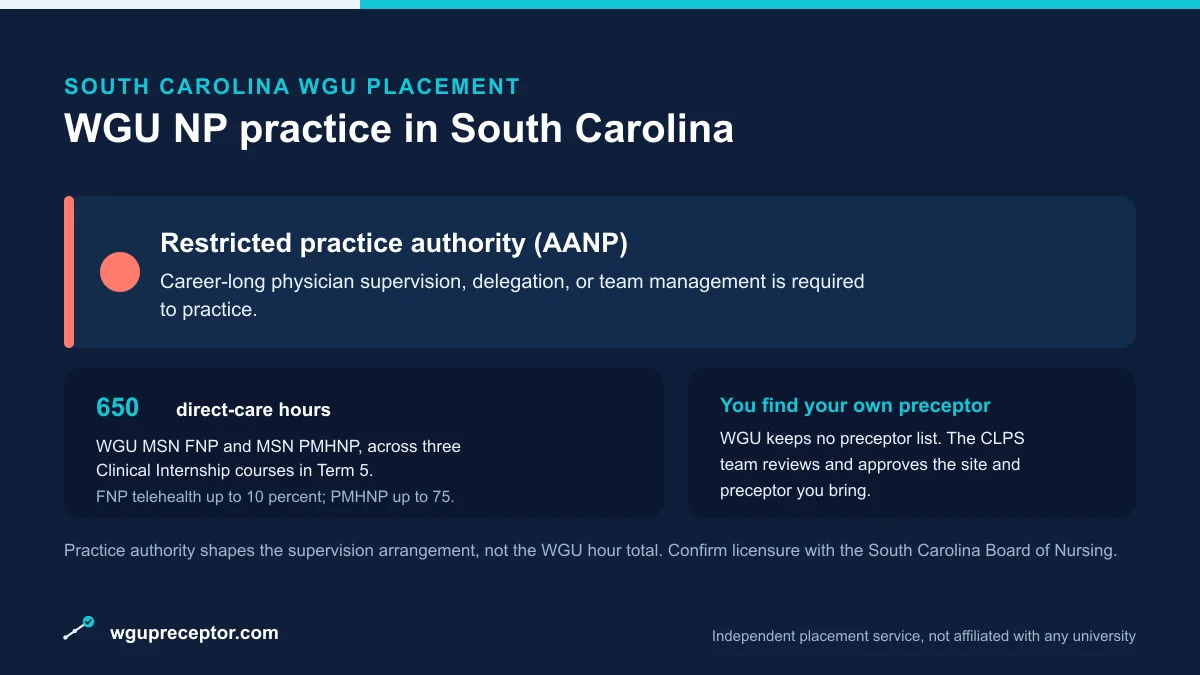
South Carolina is a restricted practice state where state rules require physician involvement in at least one element of nurse practitioner practice. WGU students identify their own sites and volunteer preceptors and complete CLPS review and affiliation work.
Restricted practice calls for detailed screening
AANP classifies South Carolina as a restricted practice state. Nurse practitioners provide assessment, diagnosis, treatment, and prescribing care within state authorization and required professional relationships. The proposed preceptor's current practice structure must satisfy those requirements.
Ask how the clinician's practice and prescribing arrangements function at the site. Then verify population focus, patient access, schedule, and teaching capacity. A compliant and experienced NP may still be unsuitable for a particular WGU FNP or PMHNP Internship.
Students remain supervised regardless of the state's category. The WGU course, site policy, and approved preceptor define the learner's role and allowed activities.
Search South Carolina by regional market
Columbia provides a central mix of primary care, behavioral health, adult care, women's health, and hospital specialties. Charleston and nearby communities form a large coastal market. Greenville and Spartanburg anchor the Upstate, with Anderson extending that radius.
Myrtle Beach offers another coastal cluster, though seasonal scheduling can affect capacity. Florence is a useful Pee Dee anchor, and Rock Hill can broaden the north central search. Smaller communities may require more travel but can offer strong continuity.
Define weekly availability and commute limits before outreach. Tell sites the WGU track, Internship course, target dates, expected hours, and university process so they can evaluate the request accurately.
Verify records through the Board of Nursing
The South Carolina Board of Nursing, within the Department of Labor, Licensing and Regulation, publishes APRN licensing information and official scope resources. Check the candidate's active credential, advanced practice role, population focus, and public record.
Request a current CV and ask about patient ages, common diagnoses, appointment volume, available days, student history, and direct supervision. Confirm meaningful primary care exposure for FNP or psychiatric assessment and management for PMHNP, depending on the course.
Identify the organizational decision maker. A clinician's interest is valuable, but a hospital, health system, or practice group may control educational approval, agreements, and onboarding.
Confirm WGU availability for the actual location
A restricted practice category does not establish whether WGU currently offers enrollment or accepts placements in South Carolina. Confirm current WGU state availability and any program or clinical restrictions before sourcing. This page is not evidence that a specific site is eligible.
Use the physical site address in the WGU question. A nearby North Carolina or Georgia practice is a different state placement and needs its own review, even if it fits the student's travel radius.
Complete the check before a practice begins an Affiliation Agreement. The process may take months, and an early location decision prevents avoidable organizational work.
Start the CLPS process early
WGU NP students identify their own clinical sites and preceptors. WGU maintains no student preceptor list. A Placement Coordinator in Clinical Learning and Placement Support, or CLPS, reviews the proposed South Carolina clinician and site and helps establish the Affiliation Agreement.
The agreement can take up to six months, so engage the coordinator about one year before Clinical Internship I. The lead time supports site review, document exchange, negotiation, and local onboarding.
South Carolina organizations may require health records, background checks, privacy education, learner applications, or orientation. A verbal yes from a volunteer preceptor does not replace CLPS and site approval.
Plan hours, sites, and telehealth by track
WGU's MSN FNP and PMHNP tracks each require 650 direct patient care hours across three Clinical Internship courses and at least two sites. Confirm the current handbook and setting rules. One South Carolina practice may support only part of the total plan.
Ask how many terms the site can host, which objectives its patient panel supports, and whether the weekly schedule can produce consistent hours. Begin identifying a second site early enough to complete its agreement before it is needed.
Current telehealth caps differ. FNP students may complete up to 10 percent, or 65 hours, using approved telehealth. PMHNP students may complete up to 75 percent. Confirm WGU acceptance, patient location, supervision, state requirements, and site policy before relying on virtual care.
Compare physical and virtual placement routes
We source physical placements and virtual preceptorship routes. A physical search can focus on South Carolina cities, regional communities, or rural practices. A virtual search can identify supervised telehealth within the track cap and subject to state, site, patient-location, course, and WGU requirements.
Students see the proposed match before payment and pay only when a placement is secured. Preceptors are unpaid volunteers. The service fee covers sourcing and coordination, with pricing on the cost page. WGU and the organization retain approval authority.
Provide your track, Internship course, target term, South Carolina region, travel radius, schedule, and telehealth needs through a free placement review. We will assess physical and virtual routes after state availability is confirmed.
Good to know
Is South Carolina a restricted practice state?
Yes. AANP categorizes South Carolina as restricted practice because state rules require physician involvement in at least one element of NP practice.
Does WGU provide South Carolina preceptors?
Students identify sites and volunteer preceptors. The CLPS Placement Coordinator reviews candidates and helps establish an Affiliation Agreement.
Why begin about one year before Internship I?
An Affiliation Agreement can take up to six months, and additional time may be needed for candidate review and site onboarding.
Can WGU PMHNP hours use telehealth?
Approved telehealth may make up to 75 percent under current PMHNP limits, subject to WGU, state, site, supervision, and patient-location rules.
Stop cold-emailing clinics
Tell us your track, your city, and your clinical timeline. We will come back with a placement plan and a realistic path to clearing your 650 hours.