Organizing an Oklahoma Preceptor Search for WGU
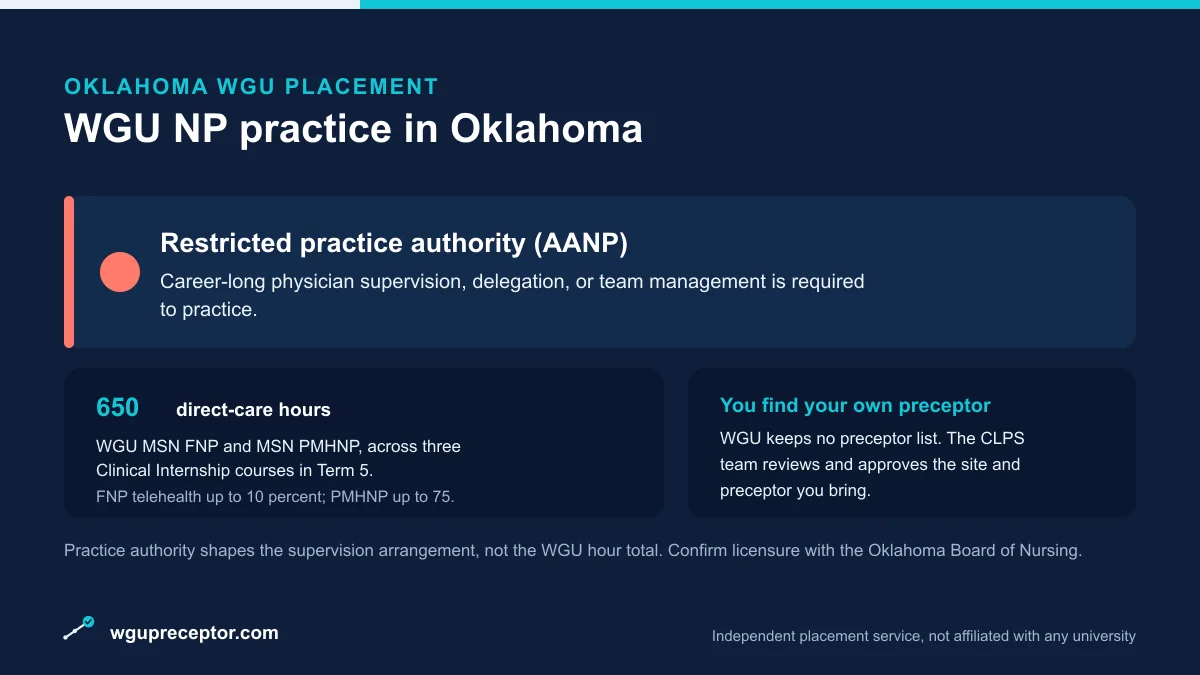
Oklahoma is a restricted practice state, although the nursing board publishes both supervised and independent prescriptive authority pathways. WGU learners still identify their own sites and volunteer preceptors and complete CLPS approval and affiliation work.
Oklahoma status requires a candidate-specific review
AANP categorizes Oklahoma as a restricted practice state. Oklahoma's Board of Nursing publishes requirements for supervised prescriptive authority and an independent prescriptive authority pathway. The proposed preceptor's current status and practice setting therefore matter more than a general assumption about all NPs in the state.
Verify which pathway applies to the clinician and whether the associated requirements are current at the site. Then confirm population focus, patient access, schedule, and teaching capacity. A prescriptive status is not a substitute for WGU course fit.
Students remain supervised regardless of the clinician's practice pathway. WGU course objectives, site policy, and the approved preceptor control the learner's clinical activity.
Confirm WGU state availability first
Before contacting Oklahoma clinicians, confirm current WGU state availability and any program or placement restrictions. AANP's category and a Board credential describe professional practice, but neither proves that WGU currently accepts an enrollment or clinical placement at a specific location.
Ask about the actual Oklahoma site address. A nearby Texas, Arkansas, Kansas, Missouri, Colorado, or New Mexico practice is a different state location and needs separate review, even if it creates a shorter commute.
This early check matters because affiliation work can take months. Do not ask a practice to begin lengthy documentation until the intended state and placement route have been confirmed with WGU.
Use Oklahoma Board of Nursing records
The Oklahoma Board of Nursing licenses nurses and APRNs and publishes official prescriptive authority guidance and credential verification. Review the proposed preceptor's active license, APRN role, population focus, applicable prescriptive authority, and public record.
Request a current CV and examine the patient environment. Ask about ages, diagnoses, clinical volume, available days, student experience, and direct supervision. PMHNP internships need meaningful psychiatric care, while FNP internships need broad primary care exposure appropriate to the current course.
Confirm the site's educational approval path. Large health systems and tribal health organizations may use centralized learner processes. Smaller groups may decide locally, but they still need an authorized contact for documents and onboarding.
Search Oklahoma by metro and regional hub
Oklahoma City, Edmond, Norman, and nearby communities form the state's largest clinical market. Tulsa and Broken Arrow provide another broad concentration of primary care, psychiatric services, specialties, and health systems. These metros offer more options but often have formal student cycles.
Lawton, Stillwater, Enid, Muskogee, and Bartlesville can widen the search. Ardmore serves south central Oklahoma, while McAlester is a southeastern anchor. Rural practices may offer continuity and wide patient exposure, though specialty depth and student capacity can be limited.
Define commute limits and required weekly shifts before outreach. Tell sites the WGU track, Internship course, term dates, expected hours, and affiliation process early so they can assess capacity.
Give CLPS enough time for an Affiliation Agreement
WGU NP students identify their preceptors and clinical sites, and WGU keeps no student preceptor list. A Placement Coordinator in Clinical Learning and Placement Support, or CLPS, reviews the proposed clinician and site and helps establish the Affiliation Agreement.
An agreement can take up to six months. Engage the coordinator about one year before Clinical Internship I. The timeline allows for site review, document exchange, agreement negotiation, and local onboarding before the planned start.
A preceptor's verbal commitment is not the final university approval. The organization may also require background screening, health documents, privacy education, or orientation, all of which should be tracked alongside CLPS work.
Plan the two-site requirement from the beginning
WGU's MSN FNP and PMHNP tracks each require 650 direct patient care hours across three Clinical Internship courses and at least two sites. Confirm the current handbook, course objectives, and eligible settings before assigning expected hours to an Oklahoma match.
Ask how many terms the practice can support and which patient experiences it can provide. Even a strong site cannot remove the requirement for at least two sites. Begin the second search early enough to allow another affiliation process if needed.
Current telehealth caps vary by track. FNP permits up to 10 percent, or 65 hours, through approved telehealth. PMHNP permits up to 75 percent through approved telehealth. Confirm current WGU rules, supervision, patient location, and course acceptance before counting remote hours.
Compare physical and virtual preceptorship
We source physical placements and virtual preceptorship routes. Physical searches can target an Oklahoma metro, regional community, or rural practice. Virtual sourcing can identify supervised telehealth possibilities subject to the track cap, state rules, patient location, site policy, course requirements, and WGU approval.
Students review the match before payment and pay only when a placement is secured. Preceptors are unpaid volunteers, and the fee covers sourcing and coordination. Pricing information is on the cost page.
Send your track, Internship course, target term, Oklahoma region, travel radius, weekly availability, and telehealth needs through a free placement review. We will assess both routes after current state availability is confirmed.
Good to know
Is Oklahoma a restricted practice state?
Yes. AANP categorizes Oklahoma as restricted practice, while the Board publishes supervised and independent prescriptive authority pathways.
Who finds a WGU preceptor in Oklahoma?
The student identifies the site and volunteer preceptor. A CLPS Placement Coordinator reviews the proposal and helps establish the Affiliation Agreement.
How long can a WGU affiliation agreement take?
It can take up to six months, so students should engage their coordinator about one year before Clinical Internship I.
Can PMHNP students use virtual preceptorship?
Approved telehealth may account for up to 75 percent under current PMHNP limits, subject to WGU, state, site, supervision, and patient-location rules.
Stop cold-emailing clinics
Tell us your track, your city, and your clinical timeline. We will come back with a placement plan and a realistic path to clearing your 650 hours.