Finding an Ohio Preceptor for WGU Clinical Internships
Ohio is a reduced practice state where certified nurse practitioners use a standard care arrangement under current state rules. WGU students identify their own sites and volunteer preceptors, then complete CLPS review and affiliation steps before clinical work.
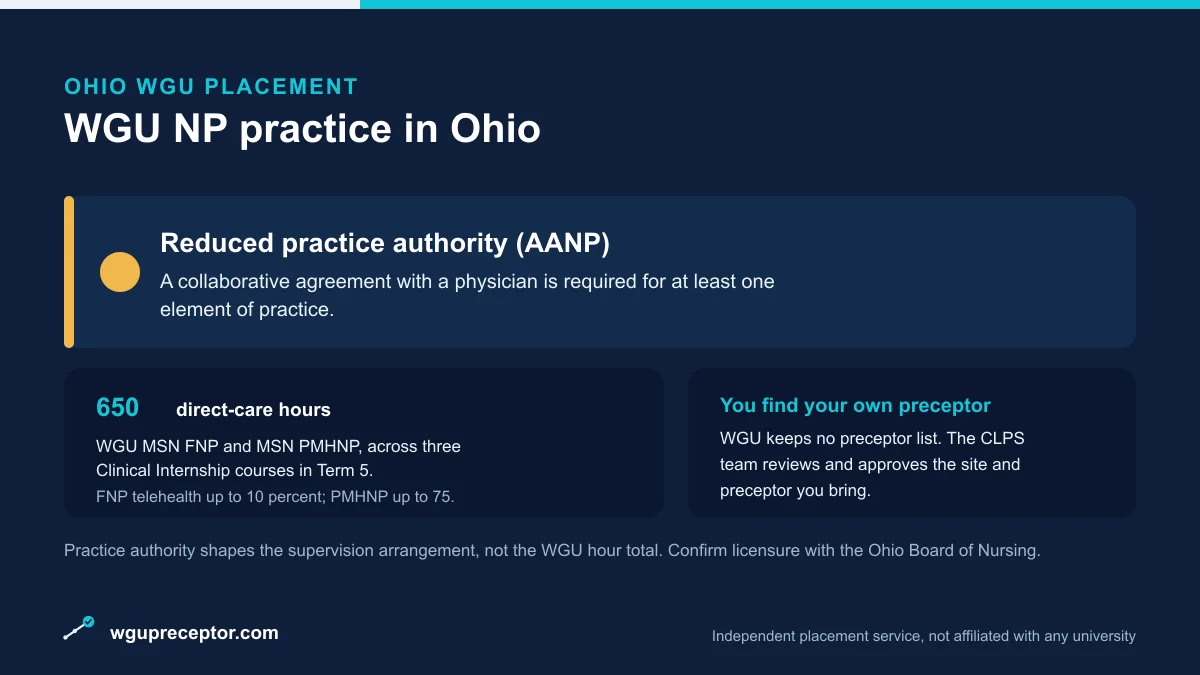
Ohio reduced practice affects candidate screening
AANP classifies Ohio as a reduced practice state. Certified nurse practitioners provide assessment, diagnosis, treatment, and prescribing services within Ohio law and a standard care arrangement. The arrangement is part of the clinician's professional practice and should be current at the proposed site.
Ask how the candidate's Ohio practice arrangement functions and whether it covers the intended setting. Then assess population focus, patient access, schedule, and teaching time. A valid state arrangement does not by itself establish that the clinician fits a WGU FNP or PMHNP Internship.
The student remains supervised regardless of the clinician's experience. WGU course objectives, site policy, and the approved preceptor determine permitted activity.
Check Ohio and WGU eligibility before outreach
Confirm current WGU state availability and any Ohio-specific program or placement restrictions before sourcing. AANP's practice category describes NP authority, not university enrollment authorization or clinical placement eligibility. This page cannot establish that WGU will accept a particular Ohio site.
Use the physical clinical address in the eligibility question. A site across the Kentucky, West Virginia, Pennsylvania, Michigan, or Indiana border is a different state location even if it is close to the student's home.
Complete this check before asking a clinic to invest time in credential packets or an Affiliation Agreement. The agreement process can be lengthy, so the correct state decision should come first.
Verify candidates with the Ohio Board of Nursing
The Ohio Board of Nursing licenses nurses and advanced practice registered nurses and provides official verification and APRN resources. Check the proposed preceptor's active license, APRN role, certification or population focus, prescriptive status where relevant, and public record.
Request a current CV and ask about patient ages, typical diagnoses, weekly visit volume, clinical schedule, experience with students, and supervision availability. FNP and PMHNP courses require different care exposure, so verify the actual patient panel rather than relying on a clinic name.
Identify the organization's education contact. Ohio health systems and large groups may centralize learner approval, while independent practices may decide locally. Both need authority to sign documents and complete onboarding.
Search Ohio by distinct clinical markets
Cleveland and Akron offer a dense mix of health systems, primary care, behavioral health, and specialty clinics. Columbus has another broad market, with surrounding communities such as Dublin, Westerville, and Grove City. Cincinnati and Dayton form separate southwestern search areas.
Toledo anchors northwestern Ohio. Youngstown provides options in the east, while Canton and Mansfield can broaden a north central search. Athens and other southeastern communities may offer rural or community care but usually require a larger travel radius and earlier outreach.
Ask about student cycles and organizational lead times. Define the Internship course, target dates, weekly availability, and expected WGU process so the site can make an informed decision.
Use CLPS for review and affiliation
WGU NP students identify their preceptors and clinical sites. WGU maintains no student preceptor list. The Placement Coordinator in Clinical Learning and Placement Support, or CLPS, reviews the proposed Ohio clinician and site and helps establish the Affiliation Agreement.
An Affiliation Agreement can take up to six months. Engage the coordinator about one year before Clinical Internship I so there is time for review, negotiation, and site onboarding. An interested preceptor is not an approved placement until the required process is complete.
Ohio organizations may require background documents, health records, privacy education, learner applications, or orientation. Keep those requirements aligned with the CLPS timeline.
Map the 650 hours across sites and modalities
WGU's MSN FNP and PMHNP tracks each require 650 direct patient care hours across three Clinical Internship courses and at least two sites. Confirm the current handbook and course requirements. One Ohio practice may support only a portion of the plan, even when it offers adequate weekly hours.
Ask whether the site can continue across more than one term, which objectives it supports, and whether a second clinical location is already necessary. Plan the two-site requirement early, since a later agreement can add months to the timeline.
Telehealth limits differ. FNP students may complete up to 10 percent, or 65 hours, through approved telehealth. PMHNP students may complete up to 75 percent through approved telehealth. WGU must confirm that the activity, patient location, site, and supervision satisfy current rules.
Use physical and virtual sourcing together
We source physical placements and virtual preceptorship routes. A physical route can target an Ohio metro, regional city, or community practice within a workable commute. A virtual route can identify supervised telehealth opportunities subject to the track cap, state requirements, patient location, site policy, course fit, and WGU approval.
Students see the match before payment and pay only when a placement is secured. Preceptors serve as unpaid volunteers. The fee covers sourcing and coordination, and pricing appears on the cost page.
Provide your track, Internship course, target term, Ohio region, travel radius, weekly schedule, and telehealth preference through a free placement review. We will compare physical and virtual options after current WGU state availability is confirmed.
Good to know
Is Ohio a reduced practice state?
Yes. AANP categorizes Ohio as reduced practice, and certified nurse practitioners use a standard care arrangement under current rules.
Does WGU maintain an Ohio preceptor list?
No. Students identify sites and preceptors, while the CLPS Placement Coordinator reviews them and helps with the Affiliation Agreement.
How many WGU NP clinical hours are required?
The MSN FNP and PMHNP tracks each require 650 direct patient care hours across three Clinical Internship courses and at least two sites. Confirm the current handbook.
Does this page confirm WGU eligibility in Ohio?
No. Confirm current WGU state availability and any placement restrictions before sourcing a clinician or site.
Stop cold-emailing clinics
Tell us your track, your city, and your clinical timeline. We will come back with a placement plan and a realistic path to clearing your 650 hours.