Plan a WGU clinical search for New Hampshire
New Hampshire is a full practice state in AANP's current framework. Its southern corridor, regional centers, and northern communities offer different WGU FNP and PMHNP search paths, while winter travel, two-site planning, and affiliation review call for an early start.
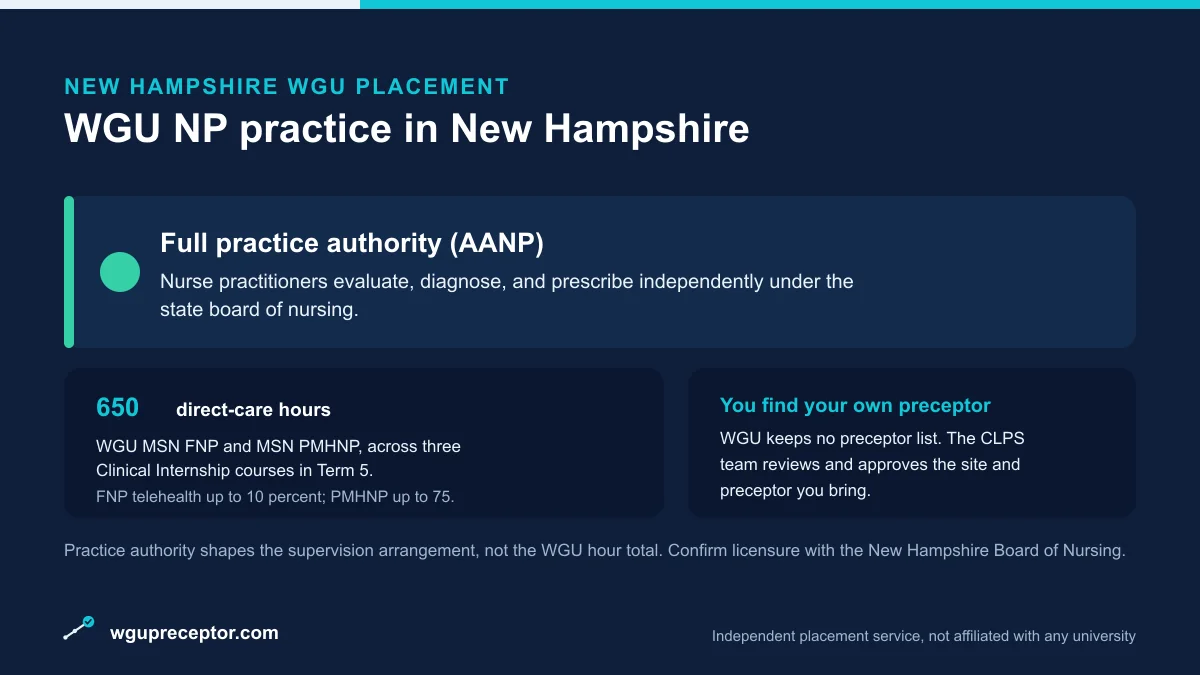
Full practice supports New Hampshire NP care
AANP identifies New Hampshire as a full practice state. Nurse practitioners can assess patients, diagnose, order and interpret tests, manage treatment, and prescribe under state law and their credentials.
Full practice does not make a WGU student independent. Students remain supervised and follow the Clinical Internship course and site policies. NPs consult other professionals when patients need added expertise.
Confirm current WGU state availability for New Hampshire before sourcing. Program restrictions can change, and this page is not evidence of enrollment or placement eligibility.
Verify the APRN through OPLC
The New Hampshire Board of Nursing operates through the Office of Professional Licensure and Certification, known as OPLC. Its nursing and APRN pages provide official requirements, applications, notices, and license services.
Search the preceptor by legal name and confirm active authority. Then review national certification, specialty, patients, role, address, and availability for CLPS review.
Match outreach to New Hampshire regions
Manchester and Nashua have the largest clinical concentration. Derry and Salem extend the southern corridor, while Concord offers community, public, hospital, and outpatient settings.
Portsmouth, Dover, and Exeter form a Seacoast market. Lebanon and Hanover anchor the Upper Valley, Keene serves the southwest, and Littleton and Berlin can matter in the north.
State the WGU track, Internship course, patients, dates, schedule, and requested preceptor information. Ask who manages students and whether an application season applies.
Lead the search with CLPS support
WGU NP students identify their own clinical sites and preceptors. WGU keeps no student preceptor list. Begin with professional contacts and New Hampshire practices selected for track fit.
The Placement Coordinator in CLPS reviews and approves the site and preceptor and helps establish the Affiliation Agreement. Facilities may add health records, screening, training, orientation, or department review.
Keep a site record with the legal name, address, student contact, patient focus, preceptor credentials, dates, capacity, and open tasks. Southern systems and northern clinics may use different processes.
Check each organization's internal deadline before relying on the Internship calendar. A clinician's interest may still require education, department, and legal review, particularly inside a larger southern New Hampshire system.
Choose an alternate region while the first request is pending. Seacoast, Concord-area, Upper Valley, southwest, and northern markets have different travel patterns and provider supply. The backup needs suitable patients and CLPS approval.
Ask how winter closures, holidays, low census, and preceptor leave affect direct patient care. Identify approved backup days and a safe travel plan instead of assuming every scheduled clinic day will occur.
Map the two required sites across the three Internship courses early. A second site should complement the first by adding needed patients, capacity, or setting fit, not function only as an emergency option.
If a practice uses telehealth, document which patients are located in New Hampshire, how supervision occurs, and which encounters are expected to be in person. This detail helps the student compare the arrangement with current track limits.
Work backward from Internship I
An Affiliation Agreement can take up to six months. Engage the Placement Coordinator about one year before Clinical Internship I. This allows WGU and the site time to review and preserves time for an alternate.
Confirm whether the exact legal entity and location are covered. Track agreement work separately from site onboarding, compliance, and winter travel planning.
Build 650 hours across three courses and two sites
WGU MSN FNP and PMHNP students each require 650 direct patient care hours across three Clinical Internship courses and at least two sites. Confirm the current handbook because current course and setting rules apply.
Discuss eligible patient volume, preceptor days, leave, holidays, weather closures, and backup days. A site may support more than one Internship, but current guidance still requires at least two sites.
WGU nursing is CCNE accredited, and WGU is accredited by NWCCU. Keep clinical tracking and compliance system names generic and follow current school instructions.
Use the track-specific telehealth cap
Current FNP guidance allows telehealth for up to 10 percent of direct patient care hours, or 65 hours. PMHNP guidance allows up to 75 percent. Confirm the handbook, course, site, New Hampshire requirements, patient location, and preceptor setup.
Our service offers physical placements and virtual preceptorship routes. Every remote or hybrid proposal still needs WGU and site acceptance.
Expand a New Hampshire search with help
We can source New Hampshire prospects by track, course, region, commute, dates, and patients and organize the match for CLPS review. Students see the match before payment and pay only when a placement is secured. Preceptors are unpaid volunteers; the fee covers sourcing and coordination. Terms appear on the cost page. Share your plan in a free placement review.
Good to know
Is New Hampshire a full practice state for NPs?
Yes. AANP currently classifies New Hampshire as full practice. Confirm current WGU state availability before sourcing.
Does WGU give students a preceptor list?
No. Students identify sites and preceptors, while the Placement Coordinator in CLPS reviews and approves each proposal.
When should agreement work start?
An Affiliation Agreement can take up to six months. Engage the Placement Coordinator about one year before Clinical Internship I.
What telehealth caps apply?
Current limits are up to 10 percent or 65 hours for FNP and up to 75 percent for PMHNP. Confirm current course and site requirements.
Stop cold-emailing clinics
Tell us your track, your city, and your clinical timeline. We will come back with a placement plan and a realistic path to clearing your 650 hours.