Create a sustainable WGU clinical plan in Montana
Montana is a full practice state under AANP's current classification. Regional need can support meaningful WGU FNP and PMHNP learning, while long distances, smaller provider pools, 650-hour planning across two sites, and affiliation review make an early search essential.
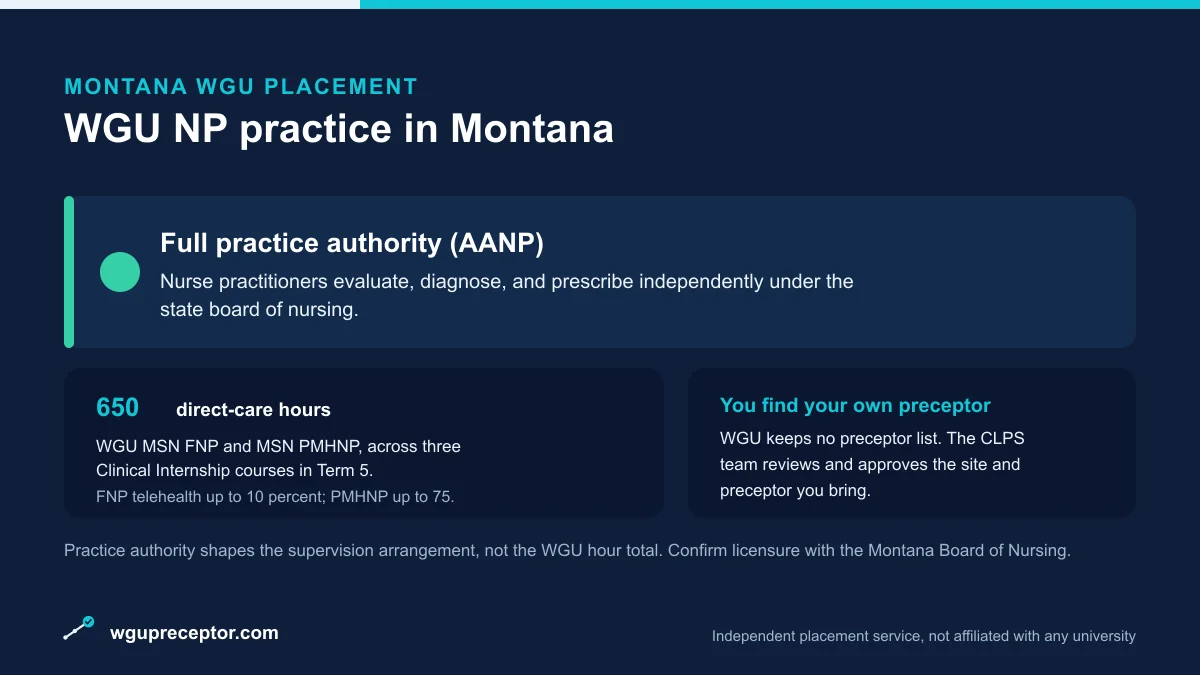
Full practice authority supports Montana NP care
AANP identifies Montana as a full practice state. Nurse practitioners can assess patients, diagnose, order and interpret tests, manage treatment, and prescribe within state law and their credentials. NPs serve metropolitan, community, regional, and rural settings.
Full practice does not make a WGU student independent. Students remain supervised and follow the Clinical Internship course and facility policies. Montana NPs also consult other professionals when patient needs require team care.
Confirm current WGU state availability for Montana before sourcing. State authority and WGU program availability are separate, and this page is not proof of enrollment or clinical placement eligibility.
Verify the Montana Board record
The Montana Board of Nursing operates through the Department of Labor and Industry. Its official website provides licensing, advanced practice, rules, applications, and credential services. Search the preceptor by legal name and confirm active nursing and APRN authority.
Then verify national certification, specialty, patients, current role, address, and availability. The WGU Placement Coordinator in CLPS reviews these details against site and Internship requirements.
Build outreach around Montana hubs
Billings has the state's largest clinical concentration, including systems, outpatient groups, behavioral health, primary care, and specialties. Missoula, Great Falls, Bozeman, Helena, Butte, and Kalispell offer other markets.
Havre, Lewistown, Glendive, and Miles City can anchor regional searches. Students farther away may need a concentrated schedule, temporary lodging, or a larger radius. Weather, provider coverage, and limited alternatives deserve attention.
Send the WGU track, Internship course, patient requirements, dates, schedule, and requested preceptor details. Ask whether a system education office or local administrator controls students.
Lead the search while coordinating with CLPS
WGU NP students identify their own preceptors and clinical sites. WGU keeps no student preceptor list. Start with professional contacts and Montana practices that serve the required FNP or PMHNP patients.
The Placement Coordinator in CLPS reviews and approves the proposed site and preceptor and helps establish the Affiliation Agreement. Facilities may add health records, screening, orientation, training, or local credentialing before clinical work begins.
Keep a record with the exact practice name, address, site contact, patient focus, preceptor credential status, weekly capacity, and open tasks. In Montana, replacing one clinician may require changing cities rather than contacting another office nearby.
Create a second travel corridor while the first request is under review. Billings, Missoula, Great Falls, and smaller regional hubs have different patient populations and provider capacity. The alternate must still fit the Internship and complete CLPS review.
Ask how low census, provider leave, weather closures, and long-distance travel affect direct patient care days. A rural site can provide broad experience but needs enough schedule margin to absorb changes without placing the student behind.
Plan the two required sites as complementary experiences. One may support a large portion of the Internship sequence, while the second should add the needed patient or setting fit rather than serving only as an emergency replacement.
Start the agreement process about a year ahead
An Affiliation Agreement can take up to six months. Engage the Placement Coordinator about one year before Clinical Internship I. Early contact gives WGU and the Montana site time to review and leaves space to identify another suitable location.
Ask whether the exact legal entity and address are covered. Track agreement review separately from personal compliance, site onboarding, travel, and course scheduling.
Plan 650 hours across three courses and two sites
WGU MSN FNP and PMHNP students each require 650 direct patient care hours across three Clinical Internship courses and at least two sites. Confirm the current handbook because patient, course, and setting requirements can change.
Discuss eligible encounters, patient volume, preceptor days, leave, holidays, weather closures, and backup scheduling. A rural site may support more than one Internship, but the full current plan still needs at least two sites.
WGU nursing is CCNE accredited, and the institution is accredited by NWCCU. Keep clinical tracking and compliance systems generic and follow current WGU instructions.
Apply the correct telehealth cap
Current FNP guidance permits telehealth for up to 10 percent of direct patient care hours, or 65 hours. PMHNP guidance permits up to 75 percent. Confirm the current handbook, course, site, Montana requirements, patient location, and preceptor setup.
Our service offers physical placements and virtual preceptorship routes. A remote or hybrid option still needs WGU and site acceptance and must stay within the current track limit.
Add sourcing support to a Montana search
We can source Montana prospects by track, course, city or corridor, travel radius, dates, and patients and organize the match for CLPS review. Students see the match before payment and pay only when a placement is secured. Preceptors are unpaid volunteers; the fee covers sourcing and coordination. Review the cost page and share your needs in a free placement review.
Good to know
Is Montana a full practice state for NPs?
Yes. AANP currently classifies Montana as full practice. Confirm current WGU state availability before beginning a site search.
Who finds a WGU preceptor in Montana?
Students identify their own sites and preceptors because WGU keeps no student preceptor list. The Placement Coordinator in CLPS reviews each proposal.
How many sites are required?
Current FNP and PMHNP guidance requires 650 direct patient care hours across three Clinical Internship courses and at least two sites. Confirm the handbook.
Can telehealth count in Montana?
Current limits are up to 10 percent or 65 hours for FNP and up to 75 percent for PMHNP. Confirm the course, site, patient location, and current guidance.
Stop cold-emailing clinics
Tell us your track, your city, and your clinical timeline. We will come back with a placement plan and a realistic path to clearing your 650 hours.