Organize a WGU clinical search across Missouri
Missouri is a restricted practice state in AANP's current framework. Two large metropolitan markets and regional hubs offer WGU FNP and PMHNP possibilities, while collaborative requirements, a two-site plan, and an Affiliation Agreement that can take months require early action.
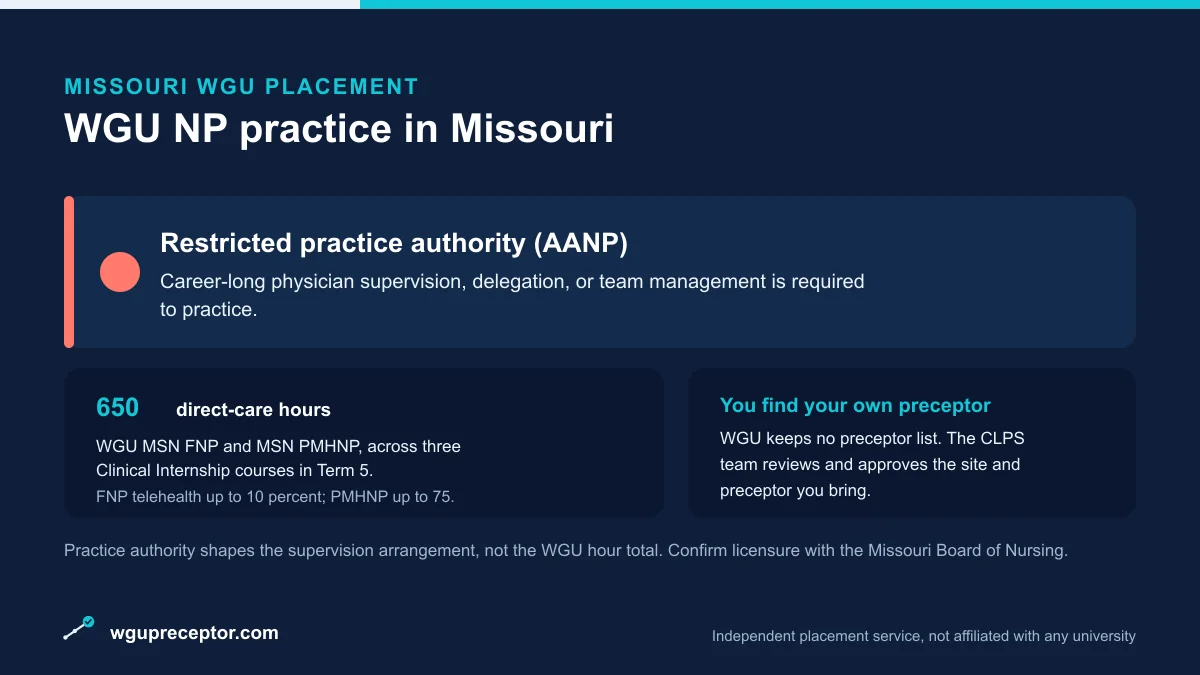
Restricted practice defines Missouri's NP structure
AANP classifies Missouri as a restricted practice state. Nurse practitioners assess patients, diagnose, manage treatment, order tests, prescribe, and coordinate care within Missouri's collaborative practice and authorization requirements.
A Missouri NP may manage visits and make daily clinical decisions while working within a documented collaborative structure. Restricted practice does not mean a physician participates in every encounter. Ask how protocols, prescribing, consultation, and review operate at the proposed clinic.
Confirm current WGU state availability for Missouri before sourcing. State practice authority does not prove program or placement eligibility, and students should ask WGU about current restrictions directly.
Use Missouri Board advanced practice resources
The Missouri Board of Nursing publishes official advanced practice guidance and credential information through the Division of Professional Registration. Search the preceptor by exact legal name and confirm the active nursing and APRN record.
Then verify national certification, specialty, patient ages, current role, address, and availability. WGU's Placement Coordinator in CLPS reviews those details with the site and Internship requirements.
Build metro and regional search lists
The Saint Louis region and Kansas City area contain Missouri's largest pools of systems, independent groups, psychiatric services, primary care, urgent care, and specialties. Include suburbs when travel is sustainable.
Springfield is a southwest hub. Columbia and Jefferson City provide central options, while Joplin and Cape Girardeau support regional searches. Rural students may need a wider radius because fewer clinicians can accept learners.
Describe the WGU track, Internship course, patients, dates, schedule, and requested preceptor details. Ask who controls student placement and whether a fixed application period applies.
Own the search and involve CLPS
WGU NP students identify their own clinical sites and preceptors. WGU keeps no student preceptor list. Begin with professional contacts, then widen outreach by track, course, and region.
The Placement Coordinator in CLPS reviews and approves the preceptor and site and helps establish the Affiliation Agreement. Missouri facilities may require health records, screening, training, orientation, or department acceptance.
Keep one record per location with the legal name, address, education contact, patients, preceptor credentials, dates, capacity, and open tasks. Large systems may move a request between departments.
Build a backup geography before the first request is decided. Saint Louis and Kansas City students may have suburban options, while regional students may compare Springfield, Columbia, Joplin, or Cape Girardeau. The alternative still needs appropriate patients and CLPS approval.
Ask how holidays, preceptor leave, patient cancellations, and internal student limits affect weekly capacity. A high-volume office can still be a poor match when the preceptor is unavailable on the student's clinic days.
Use the two-site requirement as a planning framework rather than a last-minute problem. Consider which Internship and patient experiences each proposed Missouri site can cover before submitting the full sequence.
Work backward one year from Internship I
An Affiliation Agreement can take up to six months. Engage the Placement Coordinator about one year before Clinical Internship I. Starting early allows WGU and the Missouri site to review and gives the student time to identify an alternate.
Ask whether the exact legal entity and clinic address are covered. Track agreement progress separately from facility onboarding and the student's compliance requirements.
Plan 650 hours across three courses and two sites
WGU MSN FNP and PMHNP students each require 650 direct patient care hours across three Clinical Internship courses and at least two sites. Confirm the current handbook because current course, patient, and setting expectations apply.
Ask how many eligible patients are seen, which days the preceptor works, and whether leave or another student affects capacity. One site may support more than one Internship, but the current full plan still needs at least two sites.
WGU nursing is CCNE accredited, and the institution is accredited by NWCCU. Keep clinical tracking and compliance systems generic and use current WGU tools.
Use the correct telehealth limit
Current FNP guidance allows telehealth for up to 10 percent of direct patient care hours, or 65 hours. PMHNP guidance allows up to 75 percent. Confirm the current handbook, course, site, Missouri requirements, patient location, and preceptor setup.
Our service offers physical placements and virtual preceptorship routes. A Missouri remote or hybrid option still needs WGU and site acceptance and must remain within the current track cap.
Add structured help to a Missouri search
We can source Missouri clinicians by track, course, metro or regional market, dates, commute, and patients and organize the match for CLPS review. Students see the match before payment and pay only when a placement is secured. Preceptors are unpaid volunteers; the fee covers sourcing and coordination. See the cost page and share your needs in a free placement review.
Good to know
Is Missouri a restricted practice state for NPs?
Yes. AANP currently places Missouri in the restricted category. Confirm current WGU state availability before sourcing a preceptor.
Who finds a WGU preceptor in Missouri?
Students identify their own sites and preceptors because WGU keeps no student preceptor list. CLPS reviews and approves each proposal.
How many sites does WGU require?
Current FNP and PMHNP guidance requires 650 direct patient care hours across three Internship courses and at least two sites. Confirm the handbook.
Can PMHNP use more telehealth than FNP?
Current guidance allows up to 75 percent for PMHNP and up to 10 percent or 65 hours for FNP. Confirm current course and site rules.
Stop cold-emailing clinics
Tell us your track, your city, and your clinical timeline. We will come back with a placement plan and a realistic path to clearing your 650 hours.