Finding a WGU Clinical Preceptor in Kentucky
Kentucky is an AANP reduced practice state. That category shapes how prospective NP preceptors practice, while WGU track fit, CLPS approval, affiliation, and the Internship calendar determine whether a site can be used.
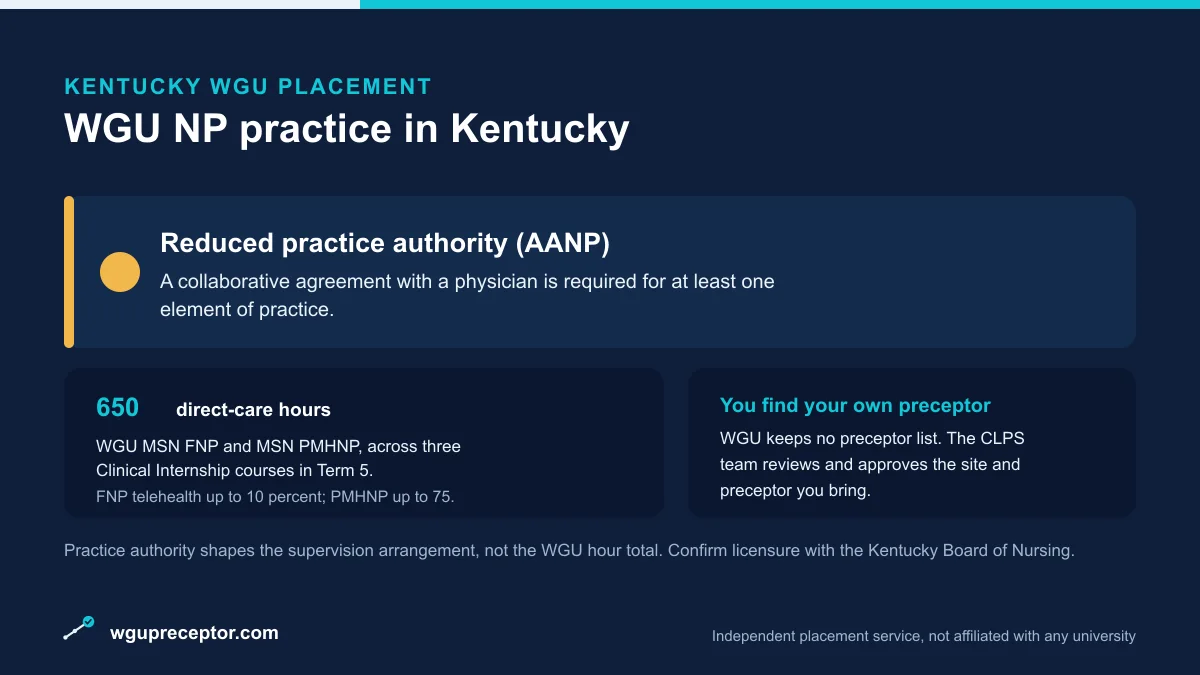
How reduced practice affects the preceptor setting
Kentucky APRNs may evaluate patients, diagnose, and manage treatment, while prescribing uses written physician agreements. The state distinguishes the CAPA-NS for nonscheduled legend drugs from the CAPA-CS for controlled substances.
Experienced prescribers who meet current Board criteria may qualify for release from an agreement requirement after four years of prescribing. Two qualified Kentucky NPs may therefore use different legal structures. The public record and current guidance should answer authority questions.
Either eligible structure can support WGU clinical teaching when the preceptor and site fit. The clinician needs current credentials, the right track and population, suitable patients, and enough time to supervise. The student remains a supervised learner.
Build a Kentucky search around real clinical markets
Louisville and Lexington offer Kentucky's widest range of systems, clinics, and specialty services. Covington, Newport, and Florence shape northern Kentucky. Bowling Green, Owensboro, Paducah, Ashland, Pikeville, and Appalachian eastern Kentucky communities add regional options.
The two largest cities attract substantial student demand. Regional and rural practices may offer continuity but have a smaller provider pool. FNP searches can use community settings, while PMHNP searches need a site with appropriate psychiatric care and supervision.
A physical site needs a commute the student can sustain across the Internship course. A virtual possibility needs its own review of patient location, privacy, technology, supervision, and site policy. Starting with track and direct patient needs prevents a convenient but unusable clinician from consuming the affiliation window.
Verify the clinician through the Kentucky Board of Nursing
The Kentucky Board of Nursing is the official source for current nursing licenses, advanced practice requirements, renewal, and discipline in Kentucky. Review its public record before investing time in a site. A practice biography may omit a recent credential change.
Board verification is an initial screen. WGU separately reviews the proposed preceptor and clinical organization. Ask whether the site accepts outside students, who controls affiliation decisions, and whether the clinician can provide the patients, direct supervision, schedule, and evaluation required for the track.
- Check current licensure and population certification
- Confirm the daily patient mix and clinical setting
- Identify the organization contact for student placement and affiliation
Start the WGU placement and affiliation process early
The student leads the WGU NP placement search and identifies both a preceptor and clinical organization. WGU does not maintain a student preceptor list. Specific outreach should name FNP or PMHNP, the Internship course, dates, desired schedule, patient population, and the documents the organization may need to provide.
The CLPS Placement Coordinator evaluates the clinician and site for approval and assists with the Affiliation Agreement. Because that agreement can take up to six months, WGU recommends involving the coordinator roughly one year before Internship I. These long planning windows make early site contact more useful than urgent cold outreach.
Keep the CLPS coordinator informed while a candidate is considered. The university review and facility onboarding control when the experience can begin. A verbal yes should remain one item on the checklist until the preceptor, site, agreement, and student requirements have cleared.
Use physical and virtual routes within track limits
Current WGU planning guidance commonly allows FNP students to complete up to 10 percent of direct patient care hours through telehealth, or up to 65 hours. PMHNP commonly allows up to 75 percent through telehealth. Confirm both limits in the current handbook, course instructions, site workflow, state rules, and patient location before scheduling virtual encounters.
Our service sources physical placements and virtual preceptorship routes. A virtual option still needs an actual preceptor, clinical site, supervised patient care, appropriate technology, and WGU acceptance. Physical and virtual candidates are screened around track, dates, population, and site readiness.
Students see the proposed match before payment and pay only when the placement is secured. WGU preceptors serve as unpaid volunteers. The service fee covers our sourcing and coordination work rather than preceptor wages, and current pricing stays on the cost page.
Plan three Internships, two sites, and direct patient hours
Clinical planning starts with 650 direct patient care hours for each WGU MSN NP track, FNP and PMHNP, as commonly published. The total is distributed through three Clinical Internship courses and at least two clinical sites. Confirm every element against the current handbook and personal degree plan.
The at-least-two-site requirement means the search should consider the whole sequence. One preceptor may provide valuable continuity, while another location supplies a different population, schedule, or part of the track. Each organization may need its own approval and agreement work.
WGU nursing holds CCNE accreditation, and WGU is institutionally accredited by NWCCU. Students should separately confirm current state and program availability. This page describes local search logistics and NP practice, not permission to enroll or complete a placement.
Request a track-specific Kentucky search review
If outreach is reaching full schedules, wrong populations, or sites unable to complete an Affiliation Agreement, send a free placement review. Include FNP or PMHNP, the Internship course, city, travel radius, clinical dates, preferred days, and whether a physical or eligible virtual option could work.
A usable match combines a qualified volunteer preceptor, the correct patients, an organization willing to host, a sustainable schedule, and enough time for CLPS and site review. Keep the Placement Coordinator involved while sourcing proceeds, and wait for required approval before beginning clinical activity.
Good to know
What is the NP practice category in Kentucky?
AANP classifies Kentucky as reduced practice. The category describes licensed NP practice. WGU students remain supervised, and CLPS reviews the proposed preceptor and site.
Does WGU give NP students a preceptor list?
No. WGU NP students identify their own preceptors and sites. A CLPS Placement Coordinator reviews the proposal and helps establish the Affiliation Agreement.
How many direct patient care hours do WGU NP students complete?
FNP and PMHNP each commonly require 650 hours across three Clinical Internship courses and at least two sites. Confirm the current handbook and degree plan.
Can a WGU Kentucky Internship use telehealth?
Possibly. FNP commonly allows up to 10 percent or 65 hours, while PMHNP commonly allows up to 75 percent. Confirm the current course, site, state, patient location, supervision, and WGU rules.
Stop cold-emailing clinics
Tell us your track, your city, and your clinical timeline. We will come back with a placement plan and a realistic path to clearing your 650 hours.