Finding a WGU Clinical Preceptor in Georgia
Georgia is an AANP restricted practice state. That category shapes how prospective NP preceptors practice, while WGU track fit, CLPS approval, affiliation, and the Internship calendar determine whether a site can be used.
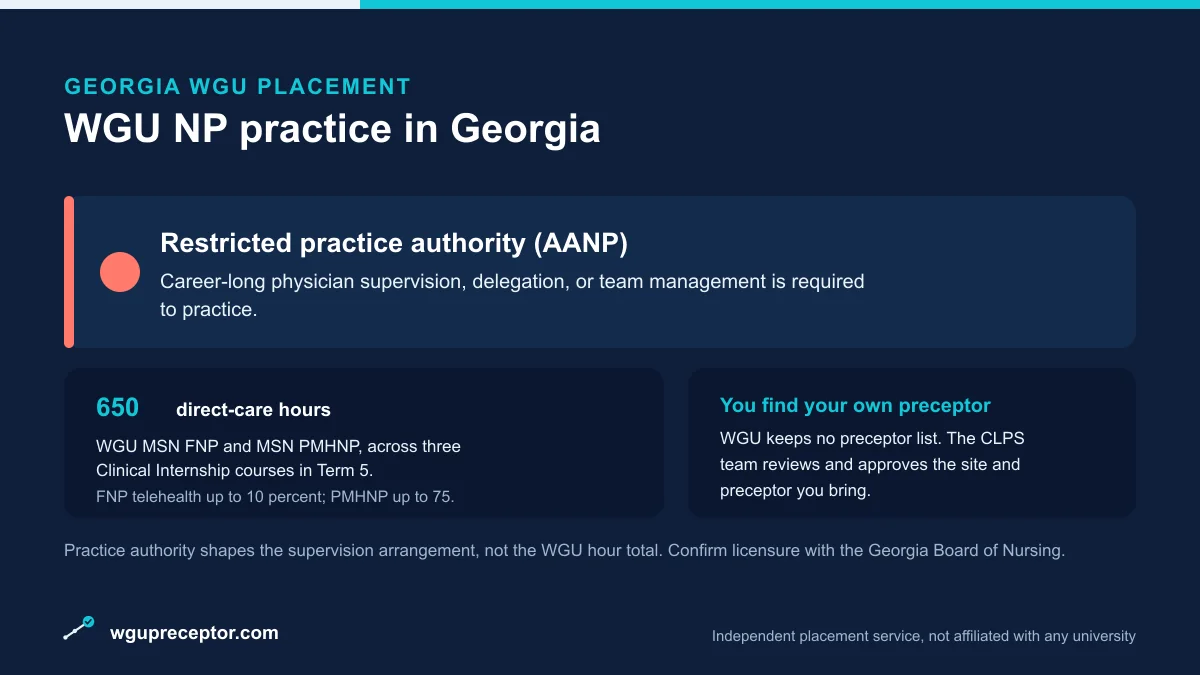
How restricted practice affects the preceptor setting
Georgia NPs practice and prescribe through nurse protocol agreements with delegating physicians. The agreement identifies delegated medical acts and prescribing authority and remains part of the NP's formal practice structure.
The delegating physician does not participate in every patient visit. Georgia NPs lead primary care, urgent care, psychiatric treatment, and hospital services within their authority and site privileges. A student decision may still involve several leaders in the practice.
Georgia grants APRN authorization on top of nursing licensure, while protocol agreements connect with physician regulation. A WGU candidate needs current nursing authority, certification, suitable patients, and the ability to supervise. WGU and the site still review the proposed experience.
Verify the clinician through the Georgia Board of Nursing
The Georgia Board of Nursing is the official source for current nursing licenses, advanced practice requirements, renewal, and discipline in Georgia. Review its public record before investing time in a site. A practice biography may omit a recent credential change.
Board verification is an initial screen. WGU separately reviews the proposed preceptor and clinical organization. Ask whether the site accepts outside students, who controls affiliation decisions, and whether the clinician can provide the patients, direct supervision, schedule, and evaluation required for the track.
- Check current licensure and population certification
- Confirm the daily patient mix and clinical setting
- Identify the organization contact for student placement and affiliation
Build a Georgia search around real clinical markets
Atlanta, Marietta, Decatur, and Lawrenceville form the densest market and face the most student competition. Augusta, Columbus, Savannah, Macon, and Athens serve large regions. Valdosta, Albany, and smaller middle and south Georgia communities can offer family or psychiatric options.
An Atlanta-only search may repeatedly reach practices committed to local programs. Regional sites can receive fewer requests but require a larger travel radius. Hospital services concentrate near major cities, while family and psychiatric care extends through community settings.
A physical site needs a commute the student can sustain across the Internship course. A virtual possibility needs its own review of patient location, privacy, technology, supervision, and site policy. Starting with track and direct patient needs prevents a convenient but unusable clinician from consuming the affiliation window.
Start the WGU placement and affiliation process early
WGU NP students identify their own preceptors and clinical sites. WGU keeps no student preceptor list, so the search begins with the student's track, Internship dates, location, direct patient needs, and weekly availability. A potential clinician and site then enter the university review process.
A Placement Coordinator in Clinical Learning and Placement Support, or CLPS, reviews and approves the proposed preceptor and site and helps establish the Affiliation Agreement. The agreement can take up to six months. WGU recommends engaging the coordinator about one year before Clinical Internship I so search and contracting time are available.
A clinician's interest is one milestone, not permission to start. The student should track preceptor information, site contacts, the Affiliation Agreement, WGU review, and organization onboarding. Clinical activity begins only after the required school and site steps are complete.
Plan three Internships, two sites, and direct patient hours
Both WGU NP tracks, FNP and PMHNP, commonly publish 650 direct patient care hours. Those hours extend across three Clinical Internship courses and at least two sites. The current handbook and degree plan should confirm the requirement for the student's start term and record.
A strong first site may cover only part of the sequence. The second site can address another schedule, patient group, clinician, or course need, but it also adds a separate organization review and Affiliation Agreement question. Build both possibilities into the early CLPS conversation.
CCNE accredits WGU's nursing programs, and NWCCU provides institutional accreditation. A state page is not evidence that WGU accepts residents or approves NP placements there. Students must verify current program availability and state conditions before asking a clinician to reserve dates.
Use physical and virtual routes within track limits
Telehealth limits differ by track. WGU commonly allows FNP telehealth up to 10 percent, which is up to 65 direct patient care hours, and PMHNP telehealth up to 75 percent. The current handbook, Internship course, clinical site, state, patient location, preceptor setup, and WGU decision control the accepted amount.
Our service preserves both physical placement and virtual preceptorship options. We search for a clinician and organization that fit the track, then help organize the placement path. WGU determines whether the proposed format, site, and supervised patient activity satisfy the program.
A student sees the proposed match before payment and pays only when placement is secured. WGU preceptors are unpaid volunteers, while the service fee covers sourcing and coordination. See how it works for the process and cost for pricing.
Request a track-specific Georgia search review
If outreach is reaching full schedules, wrong populations, or sites unable to complete an Affiliation Agreement, send a free placement review. Include FNP or PMHNP, the Internship course, city, travel radius, clinical dates, preferred days, and whether a physical or eligible virtual option could work.
A usable match combines a qualified volunteer preceptor, the correct patients, an organization willing to host, a sustainable schedule, and enough time for CLPS and site review. Keep the Placement Coordinator involved while sourcing proceeds, and wait for required approval before beginning clinical activity.
Good to know
What is the NP practice category in Georgia?
AANP classifies Georgia as restricted practice. The category describes licensed NP practice. WGU students remain supervised, and CLPS reviews the proposed preceptor and site.
Does WGU give NP students a preceptor list?
No. WGU NP students identify their own preceptors and sites. A CLPS Placement Coordinator reviews the proposal and helps establish the Affiliation Agreement.
How many direct patient care hours do WGU NP students complete?
FNP and PMHNP each commonly require 650 hours across three Clinical Internship courses and at least two sites. Confirm the current handbook and degree plan.
Can a WGU Georgia Internship use telehealth?
Possibly. FNP commonly allows up to 10 percent or 65 hours, while PMHNP commonly allows up to 75 percent. Confirm the current course, site, state, patient location, supervision, and WGU rules.
Stop cold-emailing clinics
Tell us your track, your city, and your clinical timeline. We will come back with a placement plan and a realistic path to clearing your 650 hours.