Finding a WGU Clinical Preceptor in Colorado
Colorado is an AANP full practice state. That category shapes how prospective NP preceptors practice, while WGU track fit, CLPS approval, affiliation, and the Internship calendar determine whether a site can be used.
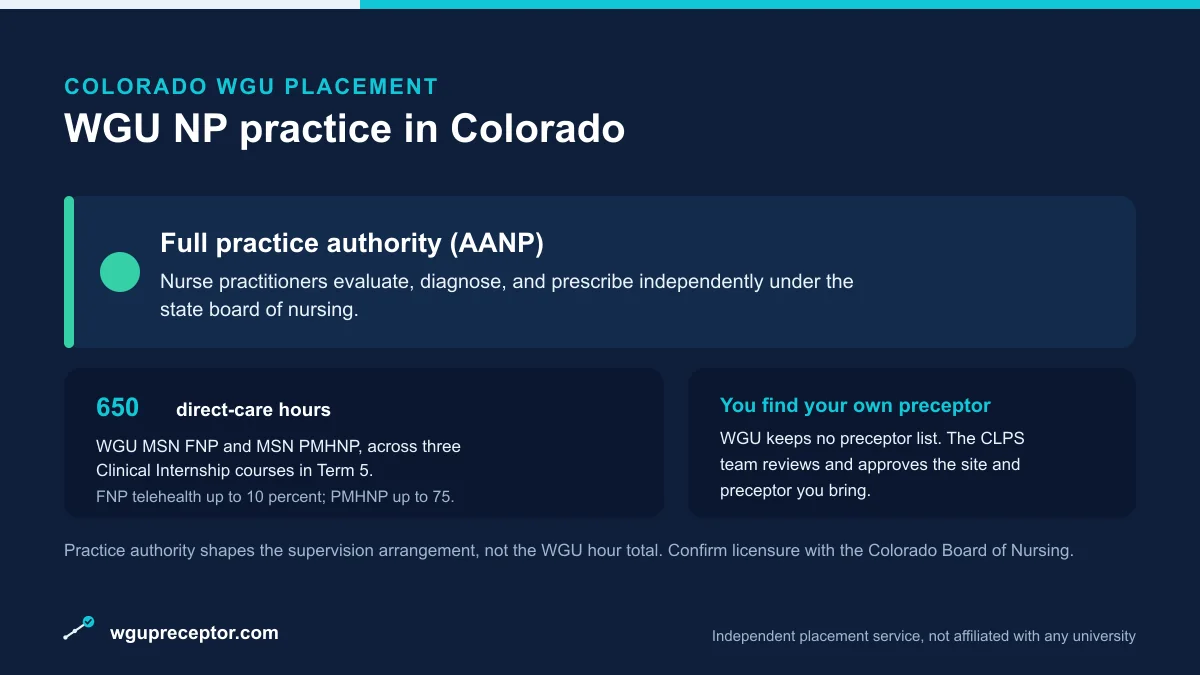
How full practice affects the preceptor setting
Colorado NPs may evaluate, diagnose, order and interpret tests, and manage treatment under the Colorado State Board of Nursing. A physician collaboration or supervision agreement is not required for ordinary NP practice.
Colorado handles prescriptive authority in stages for newer APRNs, including structured mentorship before full authority. Many experienced preceptors have completed that process, but the Board record should confirm a clinician's present credential and role.
Independent NP practices can widen a WGU search along the Front Range and in regional communities. The student still works under supervision, and WGU reviews whether the clinician, site, patients, and schedule satisfy the Internship course.
Start the WGU placement and affiliation process early
WGU expects NP students to identify their clinical sites and preceptors, and the university keeps no list from which students select a preceptor. A course-ready request gives a practice enough information to decide whether the clinician, patient panel, schedule, and organization can support the Internship.
Within CLPS, a Placement Coordinator reviews and approves the proposed preceptor and site and helps move the Affiliation Agreement. An agreement can require up to six months. WGU recommends contact with the coordinator around a year before Clinical Internship I, giving both the search and organization review room to proceed.
The student should use one calendar for sourcing, CLPS review, affiliation, and site onboarding. Hours should not begin based only on a provider's willingness. The approved clinician, approved location, completed agreement, and facility process together create the usable placement.
Verify the clinician through the Colorado State Board of Nursing
The Colorado State Board of Nursing is the official source for current nursing licenses, advanced practice requirements, renewal, and discipline in Colorado. Review its public record before investing time in a site. A practice biography may omit a recent credential change.
Board verification is an initial screen. WGU separately reviews the proposed preceptor and clinical organization. Ask whether the site accepts outside students, who controls affiliation decisions, and whether the clinician can provide the patients, direct supervision, schedule, and evaluation required for the track.
- Check current licensure and population certification
- Confirm the daily patient mix and clinical setting
- Identify the organization contact for student placement and affiliation
Build a Colorado search around real clinical markets
Denver, Aurora, Colorado Springs, Fort Collins, Boulder, Greeley, and Pueblo cover major Front Range and southern markets. Grand Junction and Montrose serve the Western Slope. Alamosa and Sterling represent smaller centers in the San Luis Valley and Eastern Plains.
The Front Range offers more sites and more competing students. Western and plains communities may receive fewer requests, while travel, weather, and small provider schedules become more important. Independent clinics can use teaching calendars different from large systems.
A physical site needs a commute the student can sustain across the Internship course. A virtual possibility needs its own review of patient location, privacy, technology, supervision, and site policy. Starting with track and direct patient needs prevents a convenient but unusable clinician from consuming the affiliation window.
Plan three Internships, two sites, and direct patient hours
WGU's MSN FNP and MSN PMHNP tracks each commonly require 650 direct patient care hours across three Clinical Internship courses and at least two clinical sites. Confirm the current handbook and individual degree plan before using that number, since program details and student records can change.
Two sites are part of planning, not an afterthought. A student may need different settings, patient populations, schedules, or clinicians across the Internship sequence. Starting the second-site discussion early reduces the risk that one strong placement becomes a bottleneck later.
WGU's nursing programs are accredited by CCNE, and the institution is accredited by NWCCU. Accreditation does not establish state availability. Confirm that WGU currently accepts residents into the selected NP track and permits the planned clinical activity in this state before sourcing a site.
Use physical and virtual routes within track limits
For FNP, WGU commonly permits telehealth for up to 10 percent of the direct patient care requirement, capped at 65 hours. For PMHNP, the commonly permitted share is up to 75 percent. Current program and course rules, the site, state, patient location, and supervision arrangement determine what can count.
We maintain physical placement sourcing and a virtual preceptorship route. Telehealth can widen the provider search, particularly for psychiatric care, but it still passes through CLPS review, the Affiliation Agreement, and site onboarding. A technology connection alone does not create an approved Internship.
The student reviews the match before making payment and pays only after placement is secured. Preceptors are unpaid volunteers under the WGU model. Our fee is for locating and coordinating the placement candidate. Service pricing is listed on cost.
Request a track-specific Colorado search review
If outreach is reaching full schedules, wrong populations, or sites unable to complete an Affiliation Agreement, send a free placement review. Include FNP or PMHNP, the Internship course, city, travel radius, clinical dates, preferred days, and whether a physical or eligible virtual option could work.
A usable match combines a qualified volunteer preceptor, the correct patients, an organization willing to host, a sustainable schedule, and enough time for CLPS and site review. Keep the Placement Coordinator involved while sourcing proceeds, and wait for required approval before beginning clinical activity.
Good to know
What is the NP practice category in Colorado?
AANP classifies Colorado as full practice. The category describes licensed NP practice. WGU students remain supervised, and CLPS reviews the proposed preceptor and site.
Does WGU give NP students a preceptor list?
No. WGU NP students identify their own preceptors and sites. A CLPS Placement Coordinator reviews the proposal and helps establish the Affiliation Agreement.
How many direct patient care hours do WGU NP students complete?
FNP and PMHNP each commonly require 650 hours across three Clinical Internship courses and at least two sites. Confirm the current handbook and degree plan.
Can a WGU Colorado Internship use telehealth?
Possibly. FNP commonly allows up to 10 percent or 65 hours, while PMHNP commonly allows up to 75 percent. Confirm the current course, site, state, patient location, supervision, and WGU rules.
Stop cold-emailing clinics
Tell us your track, your city, and your clinical timeline. We will come back with a placement plan and a realistic path to clearing your 650 hours.